


Page 39 - JCTR-10-3
P. 39
Rando et al. | Journal of Clinical and Translational Research 2024; 10(3): 212-218   213
        not uniformly effective for patients with massive or torrential   tricuspid valve surface. The scanner generates a 3D model of the
        FTR and/or those with significant leaflet tethering [2]. For these   tricuspid valve by projecting light onto the valvular surface and
        reasons, a novel  surgical  or percutaneous  repair  option  that   recording the pattern of light reflected back to the scanner. The
        addresses these shortcomings would be of significant value.  light distortions caused by the surface structures of the tricuspid
          To test novel therapies for FTR, an ex vivo model of FTR is   valve can be analyzed to generate a 3D point cloud. The point
        needed. Unfortunately, the currently available ex vivo models   cloud is then exported into a 3D scan-to-computer-aided design
        of the tricuspid valve are costly, difficult to replicate, or have   reverse  engineering  software  (Geomagic,  Morrisville,  North
        not been formally validated [3-8]. Our laboratory has previously   Carolina, USA), which allows for visualization of the tricuspid
        been successful in developing an ex vivo model of secondary   valve  as  a  3D model  and  enables  subsequent  analysis  of  the
        mitral  regurgitation  (SMR)  using  isolated  porcine  hearts  [9].   valvular geometry (Figure 3).
        Given  the  comparable  tricuspid  anatomy  between  humans
        and swine [5-8,10] we hypothesized that porcine hearts could   2.3. Induction of FTR
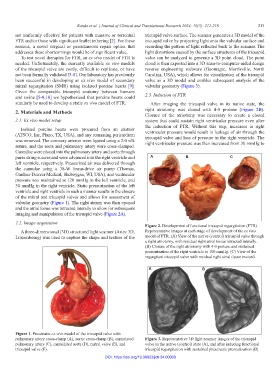
        similarly be used to develop a static ex vivo model of FTR.  After imaging the tricuspid valve in its native state, the

        2. Materials and Methods                               right atriotomy  was closed with 4-0 prolene (Figure  2B).
                                                               Closure of the  atriotomy  was necessary  to create  a closed
        2.1. Ex vivo model setup                               system that could sustain right ventricular pressure even after
                                                               the induction  of FTR.  Without this step, increases in right
          Isolated porcine hearts were procured from an abattoir
        (ATSCO, Inc, Plano, TX, USA), and any remaining pericardium   ventricular pressure would result in leakage of air through the
                                                               tricuspid valve and loss of pressure in the right ventricle. The
        was removed. The coronary arteries were ligated using a 2-0 silk   right ventricular pressure was then increased from 30 mmHg to
        suture, and the aorta and pulmonary artery were cross-clamped.
        Cannulae were placed into the pulmonary artery and aorta through
        purse string sutures and were advanced into the right ventricle and   A  B                 C
        left ventricle, respectively. Pressurized air was delivered through
        the cannulae using a 38-W linear-drive air pump (Thomas,
        Gardner-Denver Medical, Sheboygan, WI, USA), and ventricular
        pressure was maintained at 120 mmHg in the left ventricle, and
        30 mmHg in the right ventricle. Static pressurization of the left
        ventricle and right ventricle in such a manner results in the closure
        of the mitral and tricuspid valves and allows for assessment of
        valvular geometry (Figure 1). The right atrium was then opened
        and the atrial tissue was retracted laterally to allow for subsequent
        imaging and manipulation of the tricuspid valve (Figure 2A).
        2.2. Image acquisition
                                                               Figure 2. Development of functional tricuspid regurgitation (FTR).
          A three-dimensional (3D) structured light scanner (Artec 3D,   Representative images at each stage of development of the ex vivo
        Luxembourg) was used to capture the shape and texture of the   model of FTR. (A) View of the native (control) tricuspid valve through
                                                               a right atriotomy, with residual right atrial tissue retracted laterally.
                                                               (B) Closure of the right atriotomy with 4-0 prolene and sustained
                                                               pressurization of the right ventricle to 100 mmHg. (C) View of the
                                                               regurgitant tricuspid valve with residual right atrial tissue excised.


                                                                A                      B


        Figure 1. Pneumatic ex vivo model of the tricuspid valve with
        pulmonary artery cross-clamp (A), aortic cross-clamp (B), cannulated   Figure 3. Representative 3D light scanner images of the tricuspid
        pulmonary artery (C), cannulated aorta (D), mitral valve (E), and   valve in the native (control) state (A), and after inducing functional
        tricuspid valve (F).                                   tricuspid regurgitation with sustained pneumatic pressurization (B).
                                              DOI: https://doi.org/10.36922/jctr.24.00003

