


Page 40 - JCTR-10-3
P. 40
214                       Rando et al. | Journal of Clinical and Translational Research 2024; 10(3): 212-218
        100 mmHg, which mimics the right ventricular overload seen   repeated. After all rotations were completed, the average of all
        in FTR from left-sided  valvular pathology. Right ventricular   100 tenting volumes was calculated to generate a final result.
        pressure was sustained at 100 mmHg for 3 h, with the intent
        of creating progressive annular  and ventricular  enlargement   2.5. Clinical validation
        and inducing FTR. Throughout the 3-h period of sustained right   To compare  the native  geometry of the  swine and human
        ventricle pressurization, hydration of the tissues was ensured by   tricuspid valve and to validate the FTR model, the ex vivo native
        periodically adding a small amount of fluid to the right ventricle,   and FTR models were compared to publishe transesophageal
        thus humidifying the air and maintaining the integrity of the   echocardiographic (TEE)  measurements  from non-diseased
        tricuspid valve complex. Dampened towels were also applied to   (control) and FTR patients. Publications were selected if their
        the exterior surface of the heart. After 3 h, the right atrium was   methodology was well-described, and measurements  were
        excised to allow for optimal visualization of the tricuspid valve   sampled in planes similar to those described above [11-13].
        apparatus, and the tricuspid valve was imaged in its regurgitant
        state with the 3D light scanner (Figure 2C).           2.6. Statistical analysis

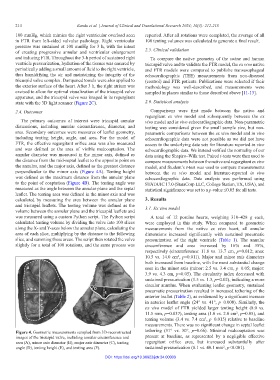
        2.4. Outcomes                                            Comparisons  were  first  made  between  the  native  and
                                                               regurgitant  ex  vivo  model  and  subsequently  between  the  ex
          The primary outcomes of interest were tricuspid annular   vivo model and in vivo echocardiographic data. Non-parametric
        dimensions, including annular circumference,  diameter, and   testing was considered given the small sample size, but non-
        area. Secondary outcomes were measures of leaflet geometry,   parametric comparisons between the ex vivo model and in vivo
        including tenting height, angle, and area. For the model of   echocardiographic data were not possible as we did not have
        FTR, the effective regurgitant orifice area was also measured   access to the underlying data sets for literature reported in vivo
        and  was  defined  as  the  area  of  visible  malcoaptation.  The   echocardiographic data. We instead verified the normality of our
        annular diameter was measured in the minor axis, defined as   data using the Shapiro–Wilk test. Paired t-tests were then used to
        the distance from the mid-septal leaflet to the opposite point on   compare measurements between the native and regurgitant ex vivo
        the annulus, and the major axis, defined as the greatest distance   model, and Student’s t-test was used to compare measurements
        perpendicular  to the  minor  axis  (Figure  4A). Tenting  height   between the  ex vivo model and literature-reported  in vivo
        was defined as the maximum distance from the annular plane   echocardiographic data. Data analysis was performed using
        to the point of coaptation (Figure 4B). The tenting angle was   STATA/IC 17.0 (StataCorp LLC, College Station, TX, USA), and
        measured as the angle between the annular plane and the septal   statistical significance was set to a p-value ≤0.05 for all tests.
        leaflet. The tenting area was defined in the minor axis and was
        calculated  by measuring  the  area  between  the  annular  plane   3. Results
        and tricuspid leaflets. The tenting volume was defined as the   3.1. Ex vivo model
        volume between the annular plane and the tricuspid leaflets and
        was measured using a custom Python script. The Python script   A total of 12 porcine hearts, weighing 310–428  g each,
        calculated tenting volume by dividing the valve into 100 slices   were employed  in this study.  When compared  to geometric
        along the X- and Y-axes below the annular plane, calculating the   measurements from the native  ex vivo heart, all annular
        area of each slice, multiplying by the distance to the following   dimensions  increased  significantly  with  sustained  pneumatic
        slice, and summing these areas. The script then rotated the valve   pressurization of the right ventricle  (Table  1). The  annular
        slightly for a total of 100 rotations, and the same process was   circumference  and area  increased  by 16% and 35%,
                                                               respectively (circumference: 11.8 vs. 13.7 cm, p=0.012; area:
                                                               10.5 vs. 14.0 cm , p=0.011). Major and minor axis diameters
                                                                             2
                                                               both increased from baseline, with the most substantial change
                                                               seen in the minor axis (minor: 2.5 vs. 3.4 cm, p=0.05; major:
                                                               3.9 vs. 4.3 cm, p=0.05). The circularity index decreased with
                                                               sustained pressurization (1.5 vs. 1.3, p=0.02), indicating a more
                                                               circular annulus. When evaluating leaflet geometry, sustained
                                                               pneumatic pressurization resulted in increased tethering of the
                                                               anterior leaflet (Table 2), as evidenced by a significant increase
                                                               in anterior leaflet angle (24° vs. 41°, p=0.008). Similarly, the
                                                               ex  vivo model  of FTR yielded  larger  tenting  height  (8.0  vs.
                                                               11.5 mm, p=0.037), tenting area (1.0 vs. 2.0 cm , p=0.05), and
                                                                                                      2
                                                               tenting volume (3.4 vs. 7.4 cm , p=0.015) relative to baseline
                                                                                        3
                                                               measurements. There was no significant change in septal leaflet
        Figure 4. Geometric measurements sampled from 3D-reconstructed   tethering  (31°  vs.  30°,  p=0.66). Minimal  malcoaptation  was
        images of the tricuspid valve, including annular circumference and   present  at  baseline,  as  represented  by  a  negligible  effective
        area (A), minor axis diameter (B), major axis diameter (C), tenting   regurgitant  orifice  area,  but  increased  substantially  after
                                                                                                2
        angle (D), tenting height (E), and tenting area (F).   sustained pressurization (8.1 vs. 40.1 mm , p<0.001).
                                              DOI: https://doi.org/10.36922/jctr.24.00003

