


Page 46 - JCTR-11-1
P. 46
Journal of Clinical and
            Translational Research                                        Hesperidin enhances repair of γ-irradiated wounds


                         A                                   B


                         C                                   D


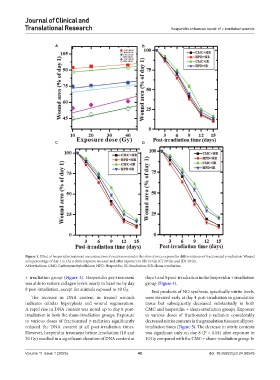
            Figure 1. Effect of hesperidin treatment on contraction of excision wound in the skin of mice exposed to different doses of fractionated γ-radiation. Wound
            area percentage of day 1 in (A) a dose-response manner and after exposure to (B) 10 Gy, (C) 20 Gy, and (D) 40 Gy.
            Abbreviations: CMC: Carboxymethylcellulose; HPD: Hesperidin; IR: Irradiation; SIR: Sham-irradiation.

            + irradiation group (Figure 3). Hesperidin pre-treatment   days 4 and 8 post-irradiation in the hesperidin + irradiation
            was able to restore collagen levels nearly to baseline by day   group (Figure 4).
            8 post-irradiation, except for animals exposed to 40 Gy.  End products of NO synthesis, specifically nitrite levels,
              The increase in DNA content in treated wounds    were elevated early at day 4 post-irradiation in granulation
            indicates cellular hyperplasia and wound regeneration.   tissue but subsequently decreased substantially in both
            A rapid rise in DNA content was noted up to day 8 post-  CMC and hesperidin + sham-irradiation groups. Exposure
            irradiation in both the sham-irradiation groups. Exposure   to various doses of fractionated  γ-radiation considerably
            to various doses of fractionated  γ-radiation significantly   decreased nitrite contents in the granulation tissues at all post-
            reduced the DNA content at all post-irradiation times.   irradiation times (Figure 5). The decrease in nitrite contents
            However, hesperidin treatment before irradiation (10 and   was significant only on day 8 (P < 0.04) after exposure to
            20 Gy) resulted in a significant elevation of DNA content at   10 Gy compared with the CMC + sham-irradiation group. In


            Volume 11 Issue 1 (2025)                        40                            doi: 10.36922/jctr.24.00049

