


Page 49 - JCTR-11-1
P. 49
Journal of Clinical and
            Translational Research                                        Hesperidin enhances repair of γ-irradiated wounds


                         A                                   B


                                      C


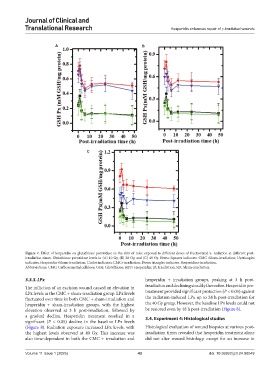
            Figure 7. Effect of hesperidin on glutathione peroxidase in the skin of mice exposed to different doses of fractionated γ- radiation at different post-
            irradiation times. Glutathione peroxidase levels in (A) 10 Gy, (B) 20 Gy, and (C) 40 Gy. Notes: Squares indicates: CMC+Sham-irradiation; Uptriangles
            indicates: Hesperidin+Sham-irradiation; Circles indicates: CMC+irradiation; Down triangles indicates: Hesperidin+irradiation.
            Abbreviations: CMC: Carboxymethylcellulose; GSH: Glutathione; HPD: Hesperidin; IR: Irradiation; SIR: Sham-irradiation.


            3.3.3. LPx                                         hesperidin + irradiation groups, peaking at 3  h post-
            The infliction of an excision wound caused an elevation in   irradiation and declining steadily thereafter. Hesperidin pre-
            LPx levels in the CMC + sham-irradiation group. LPx levels   treatment provided significant protection (P < 0.05) against
            fluctuated over time in both CMC + sham-irradiation and   the radiation-induced LPx up to 24 h post-irradiation for
            hesperidin + sham-irradiation groups, with the highest   the 40 Gy group. However, the baseline LPx levels could not
            elevation observed at 3  h post-irradiation, followed by   be restored even by 48 h post-irradiation (Figure 8).
            a gradual decline. Hesperidin treatment resulted in a   3.4. Experiment 4: Histological studies
            significant (P  < 0.05) decline in the baseline LPx levels
            (Figure 8). Radiation exposure increased LPx levels, with   Histological evaluation of wound biopsies at various post-
            the highest levels observed at 40  Gy. This increase was   irradiation times revealed that hesperidin treatment alone
            also time-dependent in both the CMC + irradiation and   did  not  alter  wound  histology,  except  for  an  increase  in


            Volume 11 Issue 1 (2025)                        43                            doi: 10.36922/jctr.24.00049

