


Page 50 - JCTR-11-1
P. 50
Journal of Clinical and
            Translational Research                                        Hesperidin enhances repair of γ-irradiated wounds


                         A                                     B


                                        C


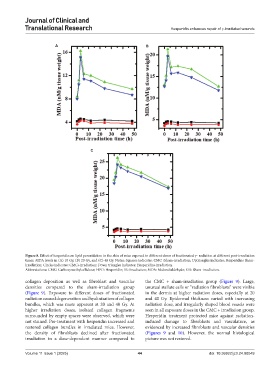
            Figure 8. Effect of hesperidin on lipid peroxidation in the skin of mice exposed to different doses of fractionated γ- radiation at different post-irradiation
            times. MDA levels in (A) 10 Gy, (B) 20 Gy, and (C) 40 Gy. Notes: Squares indicates: CMC+Sham-irradiation; Uptriangles indicates: Hesperidin+Sham-
            irradiation; Circles indicates: CMC+irradiation; Down triangles indicates: Hesperidin+irradiation.
            Abbreviations: CMC: Carboxymethylcellulose; HPD: Hesperidin; IR: Irradiation; MDA: Malondialdehyde; SIR: Sham-irradiation.

            collagen  deposition  as  well  as  fibroblast  and  vascular   the CMC + sham-irradiation group (Figure  9). Large,
            densities compared to the sham-irradiation group   unusual stellate cells or “radiation fibroblasts” were visible
            (Figure  9). Exposure to different doses of fractionated   in the dermis at higher radiation doses, especially at 20
            radiation caused degeneration and hyalinization of collagen   and 40  Gy. Epidermal thickness varied with increasing
            bundles, which was more apparent at 20 and 40  Gy. At   radiation dose, and irregularly shaped blood vessels were
            higher irradiation doses, isolated collagen fragments   seen in all exposure doses in the CMC + irradiation group.
            surrounded by empty spaces were observed, which were   Hesperidin treatment protected mice against radiation-
            not stained. Pre-treatment with hesperidin increased and   induced damage to fibroblasts and vasculature, as
            restored collagen bundles in irradiated mice. However,   evidenced by increased fibroblasts and vascular densities
            the  density  of fibroblasts declined  after  fractionated   (Figures  9 and  10). However, the normal histological
            irradiation in a dose-dependent manner compared to   picture was not restored.


            Volume 11 Issue 1 (2025)                        44                            doi: 10.36922/jctr.24.00049

