


Page 68 - JCTR-11-1
P. 68
Journal of Clinical and
            Translational Research                                                 Osteoporosis risk factors in diabetics


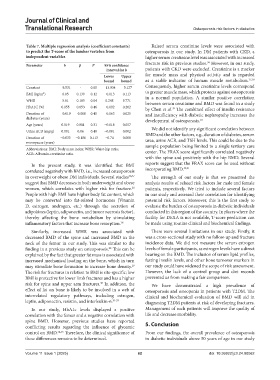
            Table 7. Multiple regression analysis (coefficient constants)   Raised serum creatinine levels were associated with
            to predict the T-score of the lumbar vertebra from   osteoporosis  in  our  study.  In  DM  patients  with  CKD,  a
            independent variables                              higher serum creatinine level was associated with increased
                                                               fracture risk in previous studies.  However, in our study,
                                                                                         36
            Parameter       b      β    P    95% confidence
                                              interval for b   patients with CKD were excluded. Creatinine is a marker
                                             Lower   Upper     for muscle mass and physical activity and is regarded
                                             bound   bound     as a stable indicator of human muscle metabolism. 37,38
            Constant       −9.531  -    0.00  −13.934  −5.127  Consequently, higher serum creatinine levels correspond
            BMI (kg/m )     0.05  0.139  0.12  −0.013  0.113   to greater muscle mass, which protects against osteoporosis
                   2
            WHR             5.01  0.185  0.04  0.248  9.771    in a normal population. A  similar positive correlation
                                                               between serum creatinine and BMD was found in a study
            HbA1C (%)      0.055  0.053  0.46  −0.092  0.202   by Chen et al.  The combined effect of insulin resistance
                                                                          39
            Duration of    −0.019  −0.068  0.40  −0.063  0.025  and insufficiency with diabetic nephropathy increases the
            diabetes (years)                                   development of osteoporosis. 10
            Age (years)    0.019  0.081  0.31  −0.018  0.057
                                                                 We did not identify any significant correlation between
            Urine ACR (mg/g)  0.001  0.06  0.40  −0.001  0.002  BMD and the other factors, e.g., duration of diabetes, serum
            Duration of    −0.033  −0.186  0.113  −0.74  0.008  urea, urine ACR, and TSH levels. This could be due to the
            menopause (years)
            Abbreviations: BMI: Body mass index; WHR: Waist-hip ratio;   sample population being limited to a single tertiary care
            ACR: Albumin-creatinine ratio.                     center. The FRAX score significantly correlated negatively
                                                               with the spine and positively with the hip BMD. Several
              In the present study, it was identified that BMI   reports suggest that the FRAX score can be used without
            correlated negatively with BMD, i.e., increased osteoporosis   incorporating BMD. 40,41
            in overweight or obese DM individuals. Several studies 26,27    The strength of our study is that we presented the
            suggest that BMD decreases in both underweight and obese   analysis results of related risk factors for male and female
            women, which correlates with higher risk for fracture.    patients, respectively. We tried to include several factors
                                                         28
            People with high BMI have higher body fat content, which   in our study and assessed their correlation for identifying
            may be  converted into  fat-related  hormones (Vitamin   potential risk factors. Moreover, this is the first study to
            D, estrogen, androgen, etc.) through the secretion of   evaluate the burden of osteoporosis in diabetic individuals
            adipokines (leptin, adiponectin, and tumor necrosis factor),   conducted in this region of the country. In places where the
            thereby affecting  the bone  metabolism by stimulating   facility for DEXA is not available, T-score prediction can
            inflammatory factors that increase bone resorption. 26  be made using routine clinical and biochemical findings.

              Similarly, increased WHR was associated with       There were several limitations in our study. Firstly, it
            decreased BMD of the spine and increased BMD in the   was a cross-sectional study with no follow-up and fracture
            neck of the femur in our study. This was similar to the   incidence data. We did not measure the serum estrogen
            finding in a previous study on osteoporosis.  This can be   levels of female participants, as estrogen levels have a direct
                                               28
            explained by the fact that greater fat mass is associated with   bearing on the BMD. The inclusion of serum lipid profiles,
            increased mechanical loading on the bone, which in turn   fasting insulin levels, and other bone turnover markers in
            may stimulate bone formation to increase bone density.    our study could have widened the scope of risk assessment.
                                                         29
            The risk for fractures in relation to BMI is site-specific; low   However, the lack of a control group and diet records
            BMI is protective for lower limb fractures and has a higher   prevented us from making a fair comparison.
            risk for spine and upper arm fractures.  In addition, the   We have demonstrated a high prevalence of
                                            30
            effect of fat on bone is likely to be involved in a web of   osteoporosis and osteopenia in patients with T2DM. The
            interrelated regulatory pathways, including estrogen,   clinical and biochemical evaluation of BMD will aid in
            leptin, adiponectin, resistin, and interleukin-6. 31-33  diagnosing T2DM patients at risk of developing fractures.
              In our study, HbA1c levels displayed a positive   Management of such patients will improve the quality of
            correlation with the femur and a negative correlation with   life and decrease morbidity.
            spine BMD. However, previous studies have reported   5. Conclusion
            conflicting results regarding the influence of glycemic
            control on BMD. 34,35  Therefore, the clinical significance of   From our findings, the overall prevalence of osteoporosis
            these differences remains to be determined.        in diabetic individuals above 50 years of age in our study


            Volume 11 Issue 1 (2025)                        62                            doi: 10.36922/jctr.24.00062

