


Page 64 - JCTR-11-1
P. 64
Journal of Clinical and
            Translational Research                                                 Osteoporosis risk factors in diabetics


            autoanalyzer (Brea, CA, USA). Thyroid-stimulating   Table 1. Comparison of general characters and laboratory
            hormone (TSH) and vitamin D levels were evaluated using   results between the two genders
            a chemiluminescent immunoassay in a Cobas 800e system   Parameter     Male (n=104;   Female   P-value
            (Basel, Switzerland).  Midstream, mid-morning  urine                     51.2%)  (n=99; 48.8%)
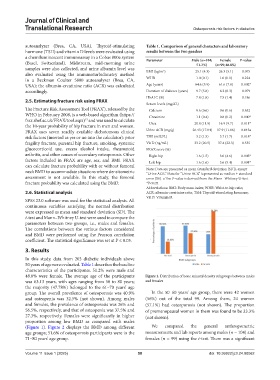
            samples were also collected, and urine albumin level was   BMI (kg/m )  25.1 (4.3)  26.3 (5.1)  0.075
                                                                      2
            also evaluated using the immunoturbidimetry method
            in  a  Beckman  Coulter  5800  autoanalyzer  (Brea,  CA,   WHR          1.0 (0.1)  1.0 (0.1)  0.224
            USA); the albumin-creatinine ratio (ACR) was calculated   Age (years)   64.6 (5.9)  61.6 (7.8)  0.002*
            accordingly.                                       Duration of diabetes (years)  9.7 (5.8)  8.2 (6.3)  0.079
                                                               HbA1C (%)            7.8 (1.8)  7.5 (1.4)  0.186
            2.5. Estimating fracture risk using FRAX
                                                               Serum levels (mg/dL)
            The Fracture Risk Assessment Tool (FRAX ), released by the   Calcium    9.6 (0.6)  9.6 (0.6)  0.632
                                             ®
            WHO in February 2008, is a web-based algorithm (https://  Creatinine    1.1 (0.4)  0.8 (0.2)  0.000*
            frax.shef.ac.uk/FRAX/tool.aspx)  and was used to calculate
                                     13
            the 10-year probability of hip fracture in men and women.   Urea        20.8 (11.9)  16.9 (9.7)  0.011*
            FRAX  uses seven  readily available  dichotomous clinical   Urine ACR (mg/g)  26.43 (17.04)  17.9 (11.08)  0.045a
            risk factors (inserted as yes or no into the calculator): prior   TSH (mIU/L)  3.2 (1.5)  3.7 (1.7)  0.018*
            fragility fracture, parental hip fracture, smoking, systemic   Vit D (ng/mL)  33.2 (20.5)  37.4 (22.3)  0.555
            glucocorticoid  use,  excess  alcohol  intake,  rheumatoid   FRAX score (%)
            arthritis, and other causes of secondary osteoporosis. Other   Right hip   1.6 (1.5)  3.0 (4.6)  0.003*
            factors included in FRAX are age, sex, and BMI. FRAX   Left hip         1.6 (1.6)  3.6 (5.4)  0.001*
            can calculate fracture probability with or without femoral
            neck BMD to accommodate situations where densitometric   Note: Data are presented as mean (standard deviation [SD]), except
                                                               “Urine ACR.” Data for “Urine ACR” is presented as median ± standard
            assessment is not available. In this study, the femoral   error (SE). a The P-value is derived from the Mann–Whitney U-test.
            fracture probability was calculated using the BMD.  *P<0.05.
                                                               Abbreviations: BMI: Body mass index; WHR: Waist-to-hip ratio;
            2.6. Statistical analysis                          ACR: albumin-creatinine ratio; TSH: Thyroid-stimulating hormone;
                                                               Vit D: Vitamin D.
            SPSS 23.0 software was used for the statistical analysis. All
            continuous variables satisfying the normal distribution
            were expressed as mean and standard deviation (SD). The
            t-test and Mann–Whitney U-test were used to compare the
            parameters between two groups, i.e., males and females.
            The correlations between the various factors considered
            and BMD were performed using the Pearson correlation
            coefficient. The statistical significance was set at P ≤ 0.05.

            3. Results
            In this study, data from 203 diabetic individuals above
            50 years of age were evaluated. Table 1 describes the baseline
            characteristics of the participants. 51.2% were male and
            48.8% were female. The average age of the participants   Figure 1. Distribution of bone mineral density subgroups between males
            was 63.13 years, with ages ranging from 50 to 80 years;   and females
            the majority (47.78%) belonged to the 61–70  years’ age
            group. The overall prevalence of osteoporosis was 40.9%   In the 50–60 years’ age group, there were 42 women
            and osteopenia was 32.5% (not shown). Among males   (56%) out of the total 99. Among them, 24 women
            and females, the prevalence of osteoporosis was 26% and   (57.1%)  had  osteoporosis  (not  shown).  The  proportion
            56.5%, respectively, and that of osteopenia was 37.5% and   of premenopausal women in them was found to be 33.3%
            27.3%, respectively. Females were significantly in higher   (not shown).
            proportion among low BMD as compared with males
            (Figure  1).  Figure  2  displays  the  BMD  among  different   We  compared  the  general  anthropometric
            age groups; 51.6% of osteoporosis participants were in the   measurements and lab reports among males (n = 104) and
            71–80 years’ age group.                            females (n = 99) using the t-test. There was a significant


            Volume 11 Issue 1 (2025)                        58                            doi: 10.36922/jctr.24.00062

