


Page 65 - JCTR-11-1
P. 65
Journal of Clinical and
            Translational Research                                                 Osteoporosis risk factors in diabetics


                                                               significant difference in BMI between the osteoporosis
                                                               group with osteopenia and normal DEXA in both sexes.
                                                               The differences in WHR were inconsistent and did not
                                                               exhibit a trend in the male and female groups.
                                                                 The anthropometric and biochemical parameters
                                                               usually advised during the follow-up of T2DM patients
                                                               were used as the dependent variables to predict the T-score
                                                               of the lumbar vertebra in all patients (Tables  5  and  6).
                                                               The overall multiple linear regression was statistically
                                                               significant (R  = 0.307;  F = 3.402; regression degrees
                                                                          2
                                                               of  freedom  [df regression ]  =  6;  residual  degrees of  freedom
                                                               [df residual ] = 196; P = 0.003). The T-score was obtained using
                                                               a constant of −9.531 and the respective values of BMI
                                                               (0.139), WHR (0.185), age (0.081), duration of T2DM
                                                               (−0.068), HbA1c (0.053), urine ACR (0.06), and duration
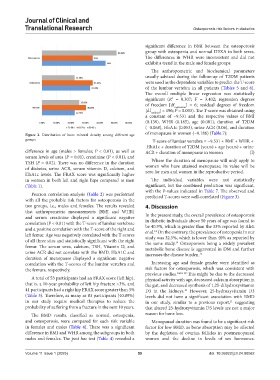
            Figure  2. Distribution of bone mineral density among different age   of menopause in women (−0.186) (Table 7):
            groups                                                T-score of lumbar vertebra = −9.531 + BMI + WHR +
                                                               HbA1c + duration of T2DM (years) + age (years) + urine
            difference in age (males > females; P < 0.01), as well as   ACR + duration of menopause in women   (I)
            serum levels of urea (P = 0.01), creatinine (P < 0.01), and
            TSH (P = 0.02). There was no difference in the duration   Where the duration of menopause will only apply to
            of diabetes, urine ACR, serum vitamin D, calcium, and   women  who  have  attained menopause; its  value  will be
            HbA1c levels. The FRAX score was significantly higher   zero for men and women in the reproductive period.
            in women in both left and right hips compared to men   The individual variables were not statistically
            (Table 1).                                         significant, but the combined prediction was significant,
                                                               with the P-values indicated in Table 7. The observed and
              Pearson correlation analysis (Table 2) was performed   predicted T-scores were well-correlated (Figure 3).
            with all the probable risk factors for osteoporosis in the
            two groups, i.e., males and females. The results revealed   4. Discussion
            that anthropometric measurements (BMI and WHR)
            and serum creatinine displayed a significant negative   In the present study, the overall prevalence of osteoporosis
            correlation (P < 0.01) with the T-score of lumbar vertebrae   in diabetic individuals above 50 years of age was found to
                                                               be 40.9%, which is greater than the 33% reported by Aleti
            and a positive correlation with the T-score of the right and   et al.  On the contrary, the prevalence of osteopenia in our
                                                                   14
            left femur. Age was negatively correlated with the T-scores   study was 32.5%, which is lower than 40% as reported by
            of all three sites and statistically significant with the right   the same study.  Osteoporosis being a widely prevalent
                                                                            14
            femur. The serum urea, calcium, TSH, Vitamin D, and   metabolic bone disease is aggravated in DM and further
            urine ACR did not correlate with the BMD. HbA1C and   increases the disease burden. 15
            duration of menopause displayed a significant negative
            correlation with the T-scores of the lumbar vertebra and   Increasing age and female gender were identified as
            the femurs, respectively.                          risk factors for osteoporosis, which was consistent with
                                                               previous studies. 14,16-18  This might be due to the decreased
              A total of 53 participants had an FRAX score (left hip),   physical activity with age, decreased calcium absorption in
            that is, a 10-year probability of left hip fracture >3%, and   the gut, and decreased synthesis of 1,25-dihydroxyvitamin
            41 participants had a right hip FRAX score greater than 3%   D3 in the kidneys.  However, 25-hydroxyvitamin D3
                                                                               19
            (Table 3). Therefore, as many as 83 participants (40.89%)   levels did not have a significant association with BMD
            in our study require medical therapies to reduce the   in  our  study,  similar  to  a  previous  report,   suggesting
                                                                                                   11
            probability of suffering from a fracture in the next 10 years.  that altered 25-hydroxyvitamin D3 levels are not a major
              The BMD results, classified as normal, osteopenia,   reason for bone loss.
            and osteoporosis, were compared for each risk variable   Menopausal duration was found to be a significant risk
            in females and males (Table  4). There was a significant   factor for low BMD, as bone absorption may be affected
            difference in BMI and WHR among the subgroups in both   by the depletion of ovarian follicles in postmenopausal
            males and females. The post hoc test (Table 4) revealed a   women and the decline in levels of sex hormones.


            Volume 11 Issue 1 (2025)                        59                            doi: 10.36922/jctr.24.00062

