


Page 69 - JCTR-11-2
P. 69
Journal of Clinical and
            Translational Research                                                 Fetal posterior fossa imaging findings


              Transabdominal ultrasound, a key component of fetal
            imaging, is complemented by fetal magnetic resonance
            imaging (MRI) as a crucial adjunct. Guidelines from
            reputable organizations such as American College of
            Obstetricians and Gynecologists (ACOG), American
            Institute of Ultrasound in Medicine (AIUM), Australasian
            Society for Ultrasound in Medicine (ASUM), National
            Health Service (NHS), and International Society of
            Ultrasound in Obstetrics and Gynecology (ISUOG)
            emphasize the importance of posterior fossa assessment
            during second-trimester pregnancy imaging.  MRI,
                                                   3-7
            when performed without contrast media, has no known
            adverse fetal effects at any stage of pregnancy.  Over the
                                                  7
            past decade, MRI has improved prenatal diagnosis of CNS
                                              8
            anomalies, especially in the posterior fossa.  Despite some
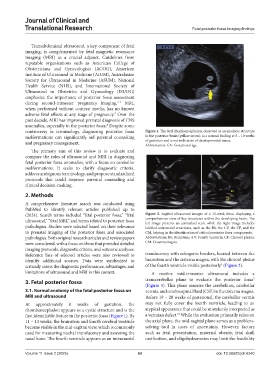
            controversy in terminology, diagnosing posterior fossa   Figure 1. The fetal rhombencephalon, observed as an anechoic structure
            malformations can significantly aid parental counseling   in the posterior brain (yellow arrow), is a normal finding at 8 – 10 weeks
            and pregnancy management.                          of gestation and is not indicative of developmental issues.
                                                               Abbreviation: GA: Gestational age.
              The primary aim of this review is to evaluate and
            compare the roles of ultrasound and MRI in diagnosing
            fetal posterior fossa anomalies, with a focus on cerebellar
            malformations. It seeks to clarify diagnostic criteria,
            address ambiguous terminology, and propose standardized
            protocols that could improve parental counseling and
            clinical decision-making.

            2. Methods
            A  comprehensive  literature search was  conducted using
            PubMed to identify relevant articles published up to
            (2024). Search terms included “fetal posterior fossa,” “fetal   Figure  2. Sagittal ultrasound images of a 13-week fetus, displaying a
            ultrasound,” “fetal MRI,” and terms related to posterior fossa   comprehensive view of key structures within the developing brain. The
                                                               left image presents an unmarked scan, while the right image includes
            pathologies. Studies were selected based on their relevance   labelled anatomical structures, such as the BS, the 4.V, the CP, and the
            to prenatal imaging of the posterior fossa and associated   CM, helping in the identification of critical posterior fossa components.
            pathologies. Both original research articles and review papers   Abbreviations: BS: Brainstem; 4.V: Fourth ventricle; CP: Choroid plexus;
            were considered, with a focus on those that provided detailed   CM: Cisterna magna.
            imaging protocols, diagnostic criteria, and outcome analyses.
            Reference lists of selected articles were also reviewed to   translucency with echogenic borders, located between the
            identify additional sources. Data were synthesized to   brainstem and the cisterna magna, with the choroid plexus
                                                                                               9
            critically assess the diagnostic performance, advantages, and   of the fourth ventricle visible posteriorly  (Figure 2).
            limitations of ultrasound and MRI in this context.   A routine mid-trimester ultrasound includes a
                                                                                                             7
            3. Fetal posterior fossa                           transcerebellar plane to evaluate  the posterior fossa
                                                               (Figure 3). This plane assesses the cerebellum, cerebellar
            3.1. Normal anatomy of the fetal posterior fossa on   vermis, and cerebrospinal fluid (CSF) in the cisterna magna.
            MRI and ultrasound                                 Before 19 – 20 weeks of gestational, the cerebellar vermis
            At  approximately  8   weeks  of  gestation,  the  may not fully cover the fourth ventricle, leading to an
            rhombencephalon appears as a cystic structure and is the   atypical appearance that could be mistakenly interpreted as
                                                                            10
            first identifiable feature in the posterior fossa (Figure 1). By   a vermian defect.  While the evaluation primarily relies on
            11 – 13 weeks, the brainstem and fourth cerebral ventricle   the axial plane, the mid-sagittal plane serves as a problem-
            become visible in the mid-sagittal view, which is commonly   solving tool in cases of uncertainty. However, factors
            used for measuring nuchal translucency and assessing the   such as fetal presentation, maternal obesity, fetal skull
            nasal bone. The fourth ventricle appears as an intracranial   ossification, and oligohydramnios may limit the feasibility


            Volume 11 Issue 2 (2025)                        63                               doi: 10.36922/jctr.6240

