


Page 74 - JCTR-11-2
P. 74
Journal of Clinical and
            Translational Research                                                 Fetal posterior fossa imaging findings


             A                     B                            A                      B


                       C

                                                                C                      D


            Figure 10. Imaging of mega cisterna magna. (A) Axial ultrasound image
            demonstrates the measurement of an enlarged cisterna magna. (B) Axial
            TRUFI and (C) Sagittal HASTE MRI images illustrate a n increased CSF   Figure  12. Multiplanar TRUFI images of a fetus. (A) Axial image
            posterior to the cerebellum, with no evidence of mass effect.  demonstrates obliteration of cisterna magna (curved black arrow).
            Abbreviations: CSF: Cerebrospinal fluid; TRUFI: True fast imaging with   (B) Sagittal image shows herniation of posterior fossa contents into
            steady-state free precession; HASTE: Half-Fourier acquisition single-shot   the cervical canal through the foramen magnum (black arrow).
            turbo spin-echo; MRI: Magnetic resonance imaging.
                                                               (C and D) Axial and sagittal images of the torso show a meningomyelocele
                                                               sac containing neural tissue (black star).
             A                     B                           Abbreviations: TRUFI: True fast imaging with steady-state free precession.

                                                               and callosal dysgenesis may negatively impact long-
                                                               term ambulatory status in some cases.  Given these
                                                                                                 43
                                                               considerations, optimal management requires lifelong
                                                               multidisciplinary care, as regular follow-ups can help
                                                               mitigate  the  risks  of  renal  disease  and  shunt-related
             C                      D                          complications. In addition, some cases of cardiopulmonary
                                                               arrest may be preventable, as they could be linked to Chiari
                                                               II malformation decompensation. 44
                                                               3.3.8. Occipital encephalocele
                                                               An encephalocele is a congenital defect characterized by

                       E                                       the protrusion of meninges, CSF, and brain tissue through
                                                               a  cranial  defect.  These  anomalies  are  categorized  based
                                                               on their location and can be either open or covered by
                                                               skin. Most congenital encephaloceles are associated
                                                               with intracranial abnormalities.  They may occur as
                                                                                          45
                                                               isolated anomalies or as part of syndromes, chromosomal
                                                               abnormalities, single-gene disorders, or due to teratogenic
                                                               influences. 46
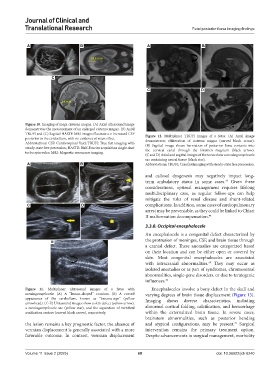
            Figure  11. Multiplanar ultrasound images of a fetus with   Encephaloceles involve a bony defect in the skull and
            meningomyelocele. (A) A “lemon-shaped” cranium. (B) A curved   varying degrees of brain tissue displacement (Figure 13).
            appearance of the cerebellum, known as “banana-sign” (yellow   Imaging shows diverse characteristics, including
            arrowhead). (C-E) Ultrasound images show a skin defect (yellow arrow),
            a meningomyelocele sac (yellow star), and the separation of vertebral   abnormal cortical folding, calcification, and hemorrhage
            ossification centers (curved black arrow), respectively.  within the externalized brain tissue. In severe cases,
                                                               brainstem abnormalities, such as posterior bending
            the lesion remains a key prognostic factor, the absence of   and atypical configurations, may be present.  Surgical
                                                                                                     47
            vermian displacement is generally associated with a more   intervention remains the primary treatment option.
            favorable outcome. In contrast, vermian displacement   Despite advancements in surgical management, morbidity


            Volume 11 Issue 2 (2025)                        68                               doi: 10.36922/jctr.6240

