


Page 70 - JCTR-11-2
P. 70
Journal of Clinical and
            Translational Research                                                 Fetal posterior fossa imaging findings


                         A                         B                        C


                         D                                      E


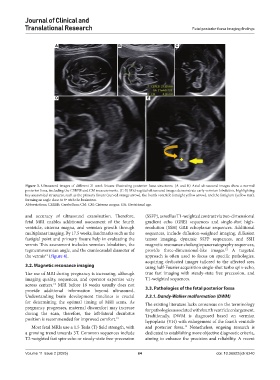
            Figure 3. Ultrasound images of different 21-week fetuses illustrating posterior fossa structures. (A and B) Axial ultrasound images show a normal
            posterior fossa, including the CEREB and CM measurements. (C-E) Mid-sagittal ultrasound images demonstrate early vermian lobulation, highlighting
            key anatomical structures, such as the primary fissure (curved orange arrow), the fourth ventricle (straight yellow arrow), and the fastigium (yellow star),
            forming an angle close to 0º with the brainstem.
            Abbreviations: CEREB: Cerebellum; CM: CM: Cisterna magna; GA: Gestational age.

            and accuracy of ultrasound examination. Therefore,   (SSFP), as well as T1-weighted contrast via two-dimensional
            fetal MRI  enables additional assessment of the fourth   gradient echo (GRE) sequences and single-shot high-
            ventricle, cisterna magna, and vermian growth through   resolution  (SSH)  GRE  echoplanar  sequences.  Additional
            multiplanar imaging. By 17.5 weeks, landmarks such as the   sequences, include diffusion-weighted imaging, diffusion
            fastigial point and primary fissure help in evaluating the   tensor imaging, dynamic SSFP sequences, and SSH
            vermis This assessment includes vermian lobulation, the   magnetic resonance cholangiopancreatography sequences,
            tegmentovermian angle, and the craniocaudal diameter of   provide three-dimensional-like images.  A targeted
                                                                                                 12
            the vermis  (Figure 4).                            approach is often used to focus on specific pathologies,
                    11
                                                               acquiring  dedicated  images  tailored  to  the  affected  area
            3.2. Magnetic resonance imaging                    using half-Fourier acquisition single-shot turbo spin-echo,
            The use of MRI during pregnancy is increasing, although   true fast imaging with steady-state free precession, and
            imaging quality, sequences, and operator expertise vary   T1-weighted sequences.
            across centers.  MRI before 18  weeks usually does not
                        12
            provide additional information beyond ultrasound.   3.3. Pathologies of the fetal posterior fossa
            Understanding brain development timelines is crucial   3.3.1. Dandy-Walker malformation (DWM)
            for determining the optimal timing of MRI scans. As   The existing literature lacks consensus on the terminology
            pregnancy progresses, maternal discomfort may increase   for pathologies associated with fourth ventricle enlargement.
            during  the scan, therefore, the  left-lateral decubitus   Traditionally, DWM is diagnosed based on vermian
            position is recommended for improved comfort. 13
                                                               hypoplasia (VH) with enlargement of the fourth ventricle
              Most fetal MRIs use a 1.5 Tesla (T) field strength, with   and posterior fossa.  Nonetheless, ongoing research is
                                                                                14
            a growing trend towards 3T. Common sequences include   dedicated to establishing more objective diagnostic criteria,
            T2-weighted fast spin-echo or steady-state free-precession   aiming to enhance the precision and reliability. A recent


            Volume 11 Issue 2 (2025)                        64                               doi: 10.36922/jctr.6240

