


Page 75 - JCTR-11-2
P. 75
Journal of Clinical and
            Translational Research                                                 Fetal posterior fossa imaging findings


                         A                                   B


                         C                       D                       E


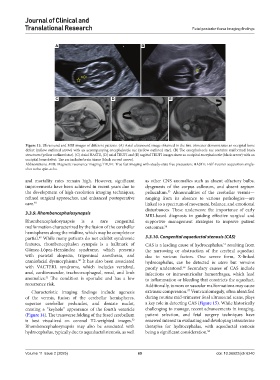
            Figure 13. Ultrasound and MRI images of different patients. (A) Axial ultrasound image obtained in the first trimester demonstrates an occipital bone
            defect (yellow outlined arrow) with an accompanying encephalocele sac (yellow outlined star). (B) The encephalocele sac contains malformed brain
            structures (yellow outlined star). (C) Axial HASTE, (D) axial TRUFI and (E) sagittal TRUFI images show an occipital encephalocele (black arrow) with an
            occipital bone defect. The sac includes brain tissue (black curved arrow).
            Abbreviations: MRI: Magnetic resonance imaging; TRUFI: True fast imaging with steady-state free precession; HASTE: Half-Fourier acquisition single-
            shot turbo spin-echo.

            and mortality  rates  remain high. However,  significant   as other CNS anomalies such as absent olfactory bulbs,
            improvements have been achieved in recent years due to   dysgenesis of the corpus callosum, and absent septum
            the  development  of  high-resolution  imaging  techniques,   pellucidum.  Abnormalities of the cerebellar vermis—
                                                                        53
            refined surgical approaches, and enhanced postoperative   ranging from its absence to various pathologies—are
            care. 48                                           linked to a spectrum of movement, balance, and emotional
                                                               disturbances.  These  underscore  the  importance  of  early
            3.3.9. Rhombencephalosynapsis
                                                               MRI-based diagnosis in guiding effective surgical  and
            Rhombencephalosynapsis  is  a   rare  congenital   supportive management strategies to improve patient
            malformation characterized by the fusion of the cerebellar   outcomes. 54
            hemispheres along the midline, which may be complete or
            partial.  While many patients do not exhibit syndromic   3.3.10. Congenital aqueductal stenosis (CAS)
                  49
            features, rhombencephalon  synapsis  is  a hallmark  of   CAS is a leading cause of hydrocephalus,  resulting from
                                                                                                55
            Gómez-López-Hernández  syndrome,  which  presents   the narrowing or obstruction of the cerebral aqueduct
            with parietal alopecia, trigeminal anesthesia, and   due  to  various  factors.  One  severe  form,  X-linked
            craniofacial dysmorphisms.  It has also been associated   hydrocephalus, can be detected  in utero but remains
                                  50
            with VACTERL syndrome, which includes vertebral,   poorly understood.  Secondary causes of CAS include
                                                                               56
            anal, cardiovascular, tracheoesophageal, renal, and limb   infections or intraventricular hemorrhages, which lead
            anomalies.   The  condition  is  sporadic  and  has  a  low   to inflammation or bleeding that constricts the aqueduct.
                    51
            recurrence risk.                                   Additionally, tumors or vascular malformations may cause
                                                                                 57
              Characteristic imaging findings include agenesis   extrinsic compression.  Ventriculomegaly, often identified
            of the vermis, fusion of the cerebellar hemispheres,   during routine mid-trimester fetal ultrasound scans, plays
            superior  cerebellar  peduncles,  and  dentate  nuclei,   a key role in detecting CAS (Figure 15). While historically
            creating  a  “keyhole”  appearance  of  the  fourth  ventricle   challenging to manage, recent advancements in imaging,
            (Figure 14). The transverse folding of the fused cerebellum   patient selection, and fetal surgery techniques have
            is best visualized on coronal T2-weighted images.    renewed interest in evaluating and developing intrauterine
                                                         52
            Rhombencephalosynapsis  may  also  be  associated  with   therapies for hydrocephalus, with aqueductal stenosis
            hydrocephalus, typically due to aqueductal stenosis, as well   being a significant consideration. 58


            Volume 11 Issue 2 (2025)                        69                               doi: 10.36922/jctr.6240

