


Page 77 - JCTR-11-2
P. 77
Journal of Clinical and
            Translational Research                                                 Fetal posterior fossa imaging findings


             A                      B                           A                       B


             C                       D
                                                                          C


             E                      F
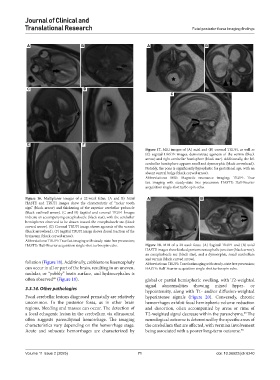
                                                               Figure 17. MRI images of (A) axial and (B) coronal TRUFI, as well as
                                                               (C) sagittal HASTE images, demonstrate agenesis of the vermis (black
                                                               arrow) and right cerebellar hemisphere (black star). Additionally, the left
                                                               cerebellar hemisphere appears small and dysmorphic (black arrowhead).
                                                               Notably, the pons is significantly hypoplastic for gestational age, with an
                                                               absent ventral bulge (black curved arrow).
                                                               Abbreviations: MRI: Magnetic resonance imaging; TRUFI: True
                                                               fast imaging with steady-state free precession; HASTE: Half-Fourier
                                                               acquisition single-shot turbo spin-echo.

            Figure  16. Multiplanar images of a 22-week fetus. (A and B) Axial   A    B
            HASTE and TRUFI images show the characteristic of “molar tooth
            sign” (black arrow) and thickening of the superior cerebellar peduncle
            (black outlined arrow). (C and D) Sagittal and coronal TRUFI İmages
            indicate an accompanying encephalocele (black star), with the cerebellar
            hemispheres observed to be drawn toward the encephalocele sac (black
            curved arrow). (E) Coronal TRUFI image shows agenesis of the vermis
            (black arrowhead). (F) Sagittal TRUFI image shows dorsal traction of the
            brainstem (black curved arrow).
            Abbreviations: TRUFI: True fast imaging with steady-state free precession;
            HASTE: Half-Fourier acquisition single-shot turbo spin-echo.  Figure  18. MRI of a 20-week fetus. (A) Sagittal TRUFI and (B) axial
                                                               HASTE images show kinked pontomesencephalic junction (black arrow),
                                                               an encephalocele sac (black star), and a dysmorphic, small cerebellum
                                                               and vermis (black curved arrow).
            foliation (Figure 18). Additinally, cobblestone lissencephaly   Abbreviations: TRUFI: True fast imaging with steady-state free precession;
            can occur in all or part of the brain, resulting in an uneven,   HASTE: Half-Fourier acquisition single-shot turbo spin-echo.
            nodular, or “pebbly” brain surface, and hydrocephalus is
            often observed  (Figure 19).                       global or partial hemispheric swelling, with T2-weighted
                        68
                                                               signal abnormalities showing mixed hyper-  or
            3.3.14. Other pathologies                          hypointensity, along with T1-  and/or diffusion-weighted
            Focal cerebellar lesions diagnosed prenatally are relatively   hyperintense signals (Figure  20). Conversely, chronic
            uncommon. In the posterior fossa, as in other brain   hemorrhages exhibit focal hemispheric volume reduction
            regions, bleeding and masses can occur. The detection of   and distortion, often accompanied by areas or rims of
            a focal echogenic lesion in the cerebellum via ultrasound   T2-weighted signal decrease within the parenchyma.  The
                                                                                                         69
            often suggests parenchymal hemorrhage. The imaging   neurological outcome is determined by the specific areas of
            characteristics vary depending on the hemorrhage stage.   the cerebellum that are affected, with vermian involvement
            Acute and subacute hemorrhages are characterized by   being associated with a poorer long-term outcome. 70


            Volume 11 Issue 2 (2025)                        71                               doi: 10.36922/jctr.6240

