


Page 78 - JCTR-11-2
P. 78
Journal of Clinical and
            Translational Research                                                 Fetal posterior fossa imaging findings


                         A                                   B


                         C                     D                         E


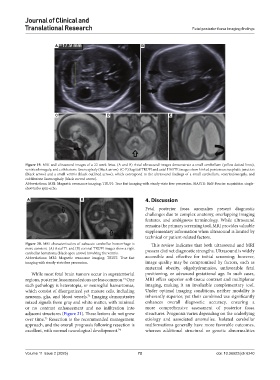
            Figure 19. MRI and ultrasound images of a 22-week fetus. (A and B) Axial ultrasound images demonstrate a small cerebellum (yellow dotted lines),
            ventriculomegaly, and cobblestone lissencephaly (black arrow). (C-E) Sagittal TRUFI and axial HASTE images show kinked pontomesencephalic junction
            (black arrow) and a small vermis (black outlined arrow), which correspond to the ultrasound findings of a small cerebellum, ventriculomegaly, and
            cobblestone lissencephaly (black curved arrow).
            Abbreviations: MRI: Magnetic resonance imaging; TRUFI: True fast imaging with steady-state free precession; HASTE: Half-Fourier acquisition single-
            shot turbo spin-echo.

             A                     B                           4. Discussion

                                                               Fetal posterior fossa anomalies present diagnostic
                                                               challenges due to complex anatomy, overlapping imaging
                                                               features, and ambiguous terminology. While ultrasound
                                                               remains the primary screening tool, MRI provides valuable
                                                               supplementary information when ultrasound is limited by
                                                               technical or patient-related factors.
            Figure  20.  MRI characterization of subacute cerebellar hemorrhage is   This review indicates that both ultrasound and MRI
            more convient. (A) Axial T1 and (B) coronal TRUFI images show a right   possess distinct diagnostic strengths. Ultrasound is widely
            cerebellar hematoma (black open arrow) involving the vermis.
            Abbreviations: MRI: Magnetic resonance imaging; TRUFI: True fast   accessible and effective for initial screening; however,
            imaging with steady-state free precession.         image quality may be compromised by factors, such as
                                                               maternal obesity, oligohydramnios, unfavorable fetal
              While most fetal brain tumors occur in supratentorial   positioning, or advanced gestational age. In such cases,
            regions, posterior fossa mass lesions are less common.  One   MRI offers superior soft-tissue contrast and multiplanar
                                                     71
            such pathology is heterotopia, or neuroglial hamartomas,   imaging, making it an invaluable complementary tool.
            which consist of disorganized yet mature cells, including   Under optimal imaging conditions, neither modality is
            neurons, glia, and blood vessels.  Imaging demonstrates   inherently superior, yet their combined use significantly
                                      72
            mixed signals from gray and white matter, with minimal   enhances overall diagnostic accuracy, ensuring a
            or no contrast enhancement and no infiltration into   more  comprehensive  assessment  of  posterior  fossa
            adjacent structures (Figure 21). These lesions do not grow   structures. Prognosis varies depending on the underlying
            over time.  Resection is the recommended management   etiology and associated anomalies. Isolated cerebellar
                    73
            approach, and the overall prognosis following resection is   malformations generally have more favorable outcomes,
            excellent, with normal neurological development. 74  whereas additional structural or genetic abnormalities


            Volume 11 Issue 2 (2025)                        72                               doi: 10.36922/jctr.6240

