


Page 72 - JCTR-11-2
P. 72
Journal of Clinical and
            Translational Research                                                 Fetal posterior fossa imaging findings


             A                     B                            A                      B


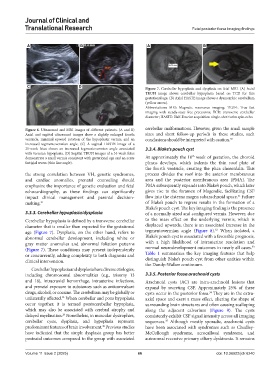
             C                     D                           Figure 7. Cerebellar hypoplasia and dysplasia on fetal MRI. (A) Axial
                                                               TRUFI image shows cerebellar hypoplasia based on TCD for this
                                                               gestational age. (B) Axial HASTE image shows a dysmorphic cerebellum
                                                               (yellow arrow).
                                                               Abbreviations: MRI: Magnetic resonance imaging; TRUFI: True fast
                                                               imaging with steady-state free precession; TCD: transverse cerebellar
                                                               diameter; HASTE: Half-Fourier acquisition single-shot turbo spin-echo.


            Figure 6. Ultrasound and MRI images of different patients. (A and B)   cerebellar malformations. However, given the small sample
            Axial and sagittal ultrasound images show a slightly enlarged fourth   sizes and short follow-up periods in these studies, such
            ventricle, minimal upward rotation of the hypoplastic vermis, and an   conclusions should be interpreted with caution. 28
            increased tegmentovermian angle. (C) A sagittal HASTE image of a
            21-week fetus shows an increased tegmentovermian angle associated   3.3.4. Blake’s pouch cyst
            with vermian hypoplasia. (D) Sagittal TRUFI images of a 34-week fetus
                                                                                   th
            demonstrate a small vermis consistent with gestational age and an acute   At approximately the 10  week of gestation, the choroid
            fastigial recess (thin line angle).                plexus develops, which indents the thin roof plate of
                                                               the  fourth  ventricle,  creating  the  plica  choroidalis.  This
            the strong correlation between VH, genetic syndromes,   process divides the roof into the anterior membranous
            and cardiac anomalies, prenatal counseling should   area and the posterior membranous area (PMA). The
            emphasize the importance of genetic evaluation and fetal   PMA subsequently expands into Blake’s pouch, which later
            echocardiography, as these findings can significantly   gives rise to the foramen of Magendie, facilitating CSF
                                                                                                      31
            impact clinical management and parental decision-  flow into the cisterna magna subarachnoid space.  Failure
            making. 21                                         of  Blake’s  pouch  to  regress  results  in  the  formation of  a
                                                               Blake’s pouch cyst. The key imaging finding is the presence
            3.3.3. Cerebellar hypoplasia/dysplasia             of a normally sized and configured vermis. However, due
            Cerebellar hypoplasia is defined by a transverse cerebellar   to the mass effect on the underlying vermis, which is
            diameter that is smaller than expected for the gestational   displaced upwards, there is an associated increase in the
                                                                                            32
            age (Figure  7). Dysplasia, on the other hand, refers to   tegmentovermian angle  (Figure  8).  When isolated, a
            abnormal cerebellar development, including white or   Blake’s pouch cyst is associated with a favorable prognosis,
            gray  matter  anomalies  and abnormal foliation patterns   with a high likelihood of intrauterine resolution and
                                                                                                            33
            (Figure  7). These conditions may present independently   normal neurodevelopment outcomes in nearly all cases.
            or concurrently, adding complexity to both diagnosis and   Table  1 summarizes the key imaging features that help
            clinical intervention.                             distinguish Blake’s pouch cyst from other entities within
                                                               the Dandy-Walker continuum.
              Cerebellar hypoplasia and dysplasia have diverse etiologies,
            including chromosomal abnormalities (e.g., trisomy 13   3.3.5. Posterior fossa arachnoid cysts
            and 18), intracranial hemorrhage, intrauterine infections,   Arachnoid cysts (AC) are intra-arachnoid lesions that
            and prenatal exposure to substances such as anticonvulsant   expand  by  secreting  CSF.  Approximately  25%  of  these
            drugs, alcohol, or cocaine. The cerebellum may be globally or   cysts occur in the posterior fossa.  They are in the extra-
                                                                                          34
            unilaterally affected.  When cerebellar and pons hypoplasia   axial space and exert a mass effect, altering the shape of
                           28
            occur together, it is termed pontocerebellar hypoplasia,   surrounding brain structures and often causing scalloping
            which may also be associated with cerebral atrophy and   along the adjacent calvarium (Figure  9). The cysts
            delayed myelination.  Nonetheless, in muscular dystrophies,   consistently exhibit CSF signal intensity across all imaging
                            29
            cerebellar cysts, dysplasia, and hypoplasia represent   sequences.  Although mostly sporadic, arachnoid cysts
                                                                       35
            predominant features of brain involvement.  Previous studies   have been associated with syndromes such as Chudley-
                                             30
            have indicated that  the simple dysplasia  group has  better   McCullough syndrome, acrocallosal syndrome, and
            postnatal outcomes compared to the group with associated   autosomal recessive primary ciliary dyskinesia. It remains

            Volume 11 Issue 2 (2025)                        66                               doi: 10.36922/jctr.6240

