


Page 66 - JCTR-11-4
P. 66
Journal of Clinical and
            Translational Research                                             AR-TAVR coaxiality assessment using 3DP


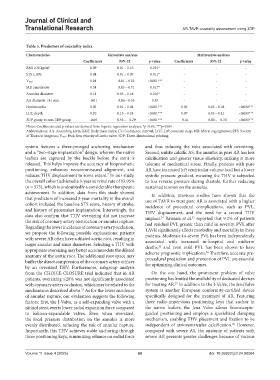
            Table 5. Predictors of coaxiality index
            Characteristics                    Univariate analysis                   Multivariate analysis
                                     Coefficients   95% CI      p‑value    Coefficients   95% CI       p‑value
            BMI ≥30 kg/m 2             0.09        0.01 – 0.16   0.021*        -             -           -
            STS ≥10%                   0.04        0.01 – 0.07   0.011*        -             -           -
            Vmax                       0.01       −0.01 – 0.02  <0.001***      -             -           -
            MR ≥moderate               0.34       −0.03 – 0.71   0.017*        -             -           -
            Annulus diameter           0.11        0.03 – 0.18   0.010*        -             -           -
            AA diameter ≥41 mm         -0.01      −0.06 – 0.03    0.55         -             -           -
            Horizocardia               0.02        0.01 – 0.04  <0.001***     0.03        0.02 – 0.04  <0.001***
            LCC depth                  0.20        0.15 – 0.24  <0.001***     0.07        0.03 – 0.11  <0.001***
            3DP group vs non-3DP group  -0.60     −0.92 – −0.29  <0.001***    −0.41      −0.80 – −0.30  <0.001***
            Notes: Coefficients and p-values are derived from logistic regression analyses. *p<0.05, ***p<0.001.
            Abbreviations: AA: Ascending aorta; BMI: Body mass index; CI: Confidence interval; LCC: Left coronary cusp; MR: Mitral regurgitation; STS: Society
            of Thoracic Surgeons; Vmax: Peak flow velocity of aortic valve; 3DP: Three-dimensional printing.

            system features a three-pronged anchoring mechanism   and thus reducing the risks associated with oversizing.
            and a “two-stage implantation” design, wherein the native   Second, unlike calcific AS, the annulus in pure AR has less
            leaflets are captured by the buckle before the stent is   calcification and greater tissue elasticity, making it more
            released. This helps improve the accuracy of bioprosthetic   tolerant of mechanical stress. Finally, patients with pure
            positioning, enhances neocommissural alignment, and   AR have increased left ventricular volume load but a lower
            reduces THV displacement to some extent.  In our study,   systolic pressure gradient, meaning the THV is subjected
                                               7
            the overall cohort achieved a 3-year survival rate of 93.95%   to less reverse pressure during diastole, further reducing
            (n = 575), which is undoubtedly a considerable therapeutic   sustained tension on the annulus.
            achievement.  In  addition,  data  from  this  study  showed   In addition, previous studies have shown that the
            that predictors of increased 3-year mortality in the overall   use of TAVR to treat pure AR is associated with a higher
            cohort included the baseline STS score, history of stroke,   incidence  of  procedural complications,  such as  PVL,
            and history of pacemaker implantation. Interestingly, the   THV displacement, and the need for a second THV
            data also confirm that THV oversizing did not increase   implant.  Rawasia et al.  reported that 9.2% of patients
                                                                      24
                                                                                   22
            the risk of coronary artery obstruction or annular rupture.   had residual PVL greater than mild in severity. PVL after
            Regarding the lower incidence of coronary artery occlusion,   TAVR significantly affects morbidity and mortality in these
            we propose the following possible explanations: patients   patients. Moderate-to-severe PVL has been independently
            with severe AR often have a dilated aortic root, resulting in
            larger annular and sinus diameters. Selecting a THV with   associated with increased in-hospital and midterm
                                                               deaths,  and even mild PVL has been shown to have
                                                                    25
            appropriate oversizing may better accommodate the dilated   adverse prognostic implications.  Therefore, accurate pre-
                                                                                         26
            anatomy of the aortic root. The additional root space may   procedural prediction and prevention of PVL are essential
            buffer the direct compression of the coronary artery orifices
            by an oversized THV. Furthermore, subgroup analysis   for optimizing clinical outcomes.
            from the CHOICE-CLOSURE trial indicated that in AR   On the one hand, the prominent problem of valve
            patients, oversizing ≤20% was not significantly associated   positioning has limited the availability of dedicated devices
            with coronary artery occlusion, which may be related to the   for treating AR.  In addition to the J-Valve, the JenaValve
                                                                           27
            mechanisms described above.  As for the lower incidence   system  is  another  European  conformity-certified  device
                                    23
            of annular rupture, our evaluation suggests the following   specifically designed for the treatment of AR. Featuring
            factors: first, the J-Valve, as a self-expanding valve with a   three  radio-impervious  positioning keys  that  anchor  in
            nitinol stent, exerts lower radial expansion force compared   the  native  leaflets,  the  Jena  Valve  allows  fluoroscopic-
            to  balloon-expandable  valves.  Even  when  oversized,   guided positioning and employs a specialized clamping
            the local pressure distribution on the annulus is more   mechanism, enabling THV placement and fixation to be
            evenly distributed, reducing the risk of annular rupture.   independent of atrioventricular calcification.  However,
                                                                                                    28
            Importantly, this THV achieves stable anchoring through   compared with severe AS, the anatomy of patients with
            three positioning keys, minimizing reliance on radial force   severe AR presents greater challenges because of various


            Volume 11 Issue 4 (2025)                        60                            doi: 10.36922/jctr.24.00084

