


Page 61 - JCTR-11-4
P. 61
Journal of Clinical and
            Translational Research                                             AR-TAVR coaxiality assessment using 3DP


            Table 1. Baseline characteristics
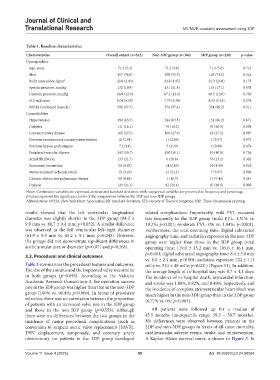
            Characteristics                   Overall cohort (n=612)  Non‑3DP group (n=384)  3DP group (n=228)  p‑value
            Demographics
             Age, years                            71.2 (5.3)          71.2 (5.6)         71.3 (5.0)    0.715
             Men                                   453 (74.0)          290 (75.5)         163 (71.5)    0.316
             Body mass index, kg/m 2               22.6 (2.03)         22.8 (1.97)        22.3 (2.08)   0.173
             Systolic pressure, mmHg               132 (19.9)          131 (21.4)         133 (17.1)    0.478
             Diastolic pressure, mmHg              66.9 (12.0)         67.2 (12.1)        66.5 (12.0)   0.750
             STS risk score                        8.04 (3.35)         7.75 (3.39)        8.33 (3.14)   0.274
             NYHA functional class≥III             598 (97.7)          374 (97.4)         224 (98.2)    0.511
            Comorbidities
             Hypertension                          390 (63.7)          244 (63.5)         151 (66.2)    0.671
             Diabetes                              111 (18.1)          70 (18.2)          47 (20.6)     0.598
             Coronary artery disease               168 (27.5)          106 (27.6)         62 (27.2)     0.987
             Previous percutaneous coronary intervention  18 (2.94)    11 (2.86)           7 (3.07)     0.973
             Previous bypass graft surgery          7 (1.14)            5 (1.30)           2 (0.88)     0.476
             Peripheral vascular disease           243 (39.7)          150 (39.1)         93 (40.8)     0.736
             Atrial fibrillation                   133 (21.7)           0 (20.8)          53 (23.2)     0.362
             Permanent pacemaker                   24 (3.92)           14 (3.65)          10 (4.39)     0.810
             Stroke/transient ischemic attack      19 (3.10)           12 (3.12)           7 (3.07)     0.996
             Chronic obstructive pulmonary disease  58 (9.48)           1 (10.7)          17 (7.46)     0.241
             Dialysis                              129 (21.1)          82 (21.4)          47 (20.6)     0.909
            Notes: Continuous variables are expressed as mean and standard deviation, while categorical variables are presented as frequency and percentage.
            p-values represent the significance levels of the comparisons between the 3DP and non-3DP groups.
            Abbreviations: NYHA: New York Heart Association; SD: Standard deviation; STS: Society of Thoracic Surgeons; 3DP: Three-dimensional printing.

            results showed that the left ventricular longitudinal   related complications. Importantly, mild PVL occurred
            diameter was slightly shorter in the 3DP group (84.2 ±   less frequently in the 3DP group (mild PVL: 3.51% vs.
            9.9 mm vs. 88.7 ± 9.4 mm; p=0.032). A similar difference   18.2%; p<0.001; moderate PVL: 0% vs. 1.04%; p<0.001).
            was observed in the left ventricular left–right diameter   Furthermore, the total operating time, digital subtracted
            (61.9 ± 9.9  mm vs. 65.2 ± 9.1  mm;  p=0.043). However,   angiography time, and radiation exposure in the non-3DP
            the groups did not demonstrate significant differences in   group were higher than those in the 3DP group (total
            aortic annular area or diameter (p=0.071 and p=0.266).  operating time:  119.0  ±  15.2  min vs.  105.0  ±  16.1  min,
            3.2. Procedural and clinical outcomes              p<0.001; digital subtracted angiography time: 8.4 ± 3.0 min
                                                               vs. 6.0 ± 2.4 min, p<0.001; radiation exposure: 722 ± 113
            Table 3 summarizes the procedural features and outcomes.   mGy vs. 514 ± 48 mGy, p<0.001) (Figure S1). In addition,
            The size of the annulus and the implanted valve was similar   the average length of in-hospital stay was 8.7 ± 4.1 days.
            in both groups (p=0.693). According to the Valvular   The incidence of in-hospital death, myocardial infarction,
            Academic Research Consortium-3, the operation success   and stroke was 1.80%, 0.82%, and 0.49%, respectively, and
            rate in the 3DP group was higher than that in the non-3DP   the incidence of complete atrioventricular heart block was
            group (100% vs. 96.4%; p=0.008). In terms of prosthesis   much higher in the non-3DP group than in the 3DP group
            selection, there was no correlation between the proportion   (6.77% vs. 0%; p<0.001).
            of patients with an increased valve size in the 3DP group
            and those in the non-3DP group (p=0.553). Although   All patients were followed up for a median of
            there were no differences between the two groups in the   45.5  months (interquartile range: 39.2 – 50.7  months).
            incidence of major procedural complications (such as   No differences were observed between patients in the
            conversion  to surgical  aortic  valve replacement  [SAVR],   3DP and non-3DP groups in terms of all-cause mortality,
            THV displacement, tamponade, and coronary artery   cardiovascular adverse events, stroke, and reintervention.
            obstruction), no patients in the 3DP group developed   A Kaplan–Meier survival curve is shown in Figure 3. In


            Volume 11 Issue 4 (2025)                        55                            doi: 10.36922/jctr.24.00084

