


Page 88 - JCTR-11-5
P. 88
Journal of Clinical and
            Translational Research                                                  ROCK inhibition in chronic rejection


            3. Results                                         Supplements were already published in our previous
                                                               publication.  All genes considered differentially expressed
                                                                        10
            In all our analyses, we purposely used non-activated (M0)   compared to the control (DMSO-treated) cells had a
            macrophages. M0 (or naïve) macrophages are in a resting   p≤0.05 and ‖log  fold change‖ > 0. Pathways associated with
                                                                           2
            state and serve as precursors to polarized macrophages.   these DEGs were identified using Metascape.
            It is known that the transcription and protein expression
            profiles of activated macrophages depend on the type   3.2. Effect of Rezurock/fingolimod combination on
            (direction) of polarization (M1 vs. M2), and particularly   mouse peritoneal macrophages
            on the specific type of activator. In addition, our previous   The combination treatment of macrophages with Rezurock
            research showed that the response of M0 macrophages   and  fingolimod  resulted  in  the  differential  expression  of
            to RhoA/ROCK inhibition is very similar to that of   4,855 genes (2,477 downregulated and 2,378 upregulated)
            M2 macrophages but differs from the response of M1   compared to the DMSO control (Figure 2A). In the volcano
            macrophages.  Both  M0  and  M2  macrophages  exhibit   plot, green dots represent upregulated genes, whereas red
            high levels of RhoA messenger RNA (mRNA), whereas   dots represent downregulated genes. The distribution
            M1 macrophages express RhoA mRNA at approximately   of the DEGs is depicted in the heatmap (Figure  2B).
            three times lower levels.  Thus, to obtain “basic” or naïve   The downregulated genes were related to the cell cycle,
                               11
            transcriptomic and proteomic data, we chose to use non-  DNA metabolic processes, neutrophil degranulation,
            activated (M0) macrophages.                        chromosome organization, leukocyte proliferation, and
                                                               cytokine  production  (Figure  2C;  Tables  S1 and  S2).  The
            3.1. RNA sequencing                                upregulated genes were associated with protein processing,
            We performed RNA sequencing of mouse peritoneal    membrane trafficking, Rho GTPase signaling, autophagy,
            macrophages after combined treatment with Rezurock   Golgi organization, neuron projection development, and
            and fingolimod. The data were then compared with our   histone modification (Figure 2D; Tables S3 and S4).
            previously published results from individual treatments   Our previously published work showed that
            with Rezurock or fingolimod in mouse peritoneal    Rezurock is superior to fingolimod in modulating the
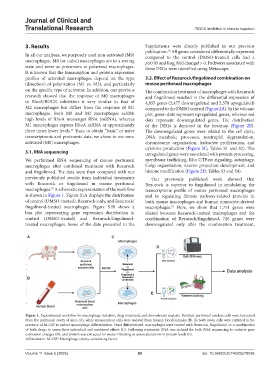
            macrophages.  A schematic representation of the workflow   transcriptome profile of mouse peritoneal macrophages
                       10
            is shown in Figure 1. Figure S1A displays the distribution   and in regulating fibrosis pathway-related proteins in
            of control (DMSO-treated), Rezurock-only, and Rezurock/  both mouse macrophages and human monocyte-derived
            fingolimod-treated  macrophages.  Figure  S1B  shows  a   macrophages.  Here, we show that 1,751 genes were
                                                                          10
            box  plot representing  gene expression distribution in   shared between Rezurock-treated macrophages and the
            control (DMSO-treated) and Rezurock/fingolimod-    combination  of  Rezurock/fingolimod,  726  genes  were
            treated macrophages. Some of the data presented in the   downregulated only after the combination treatment,

             A                                  C

                                                                    D


             B


                                                                 E


            Figure 1. Experimental workflow for macrophage isolation, drug treatment, and downstream analysis. Resident peritoneal exudate cells were harvested
            from the peritoneal cavity of mice (A), while mononuclear cells were isolated from human blood samples (B). In both cases, cells were cultured in the
            presence of M-CSF to induce macrophage differentiation. Once differentiated, macrophages were treated with Rezurock, fingolimod, or a combination
            of both drugs to assess their individual and combined effects (C). Following treatment, RNA was isolated for bulk RNA sequencing to evaluate gene
            expression changes (D), and protein was extracted for western blotting to assess alterations in protein levels (E).
            Abbreviation: M-CSF: Macrophage colony-stimulating factor.


            Volume 11 Issue 5 (2025)                        82                         doi: 10.36922/JCTR025270036

