


Page 93 - JCTR-11-5
P. 93
Journal of Clinical and
            Translational Research                                                  ROCK inhibition in chronic rejection


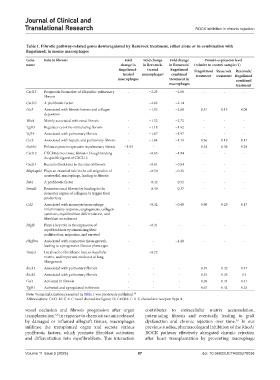
            Table 1. Fibrotic pathway‑related genes downregulated by Rezurock treatment, either alone or in combination with
            fingolimod, in mouse macrophages
            Gene    Role in fibrosis                  Fold    Fold change   Fold change   Protein expression level
            name                                    change in   in Rezurock‑   in Rezurock/  (relative to control sample=1)
                                                    fingolimod‑   treated   fingolimod   Fingolimod  Rezurock  Rezurock/
                                                     treated   macrophages a  combined   treatment  treatment fingolimod
                                                   macrophages           treatment in                combined
                                                                         macrophages                 treatment
            Cxcl13  Prognostic biomarker of idiopathic pulmonary   -  −2.23  −2.58      -       -        -
                    fibrosis
            Cxcl10  A profibrotic factor               -        −2.02       −2.14       -       -        -
            Ptx3    Associated with fibrotic lesions and collagen   -  −1.92  −2.68    0.51    0.15     0.08
                    deposition
            Wnt4    Mainly associated with renal fibrosis  -    −1.52       −2.72       -       -        -
            Tgfb3   Regulates cytokine-stimulating fibrosis  -  −1.18       −1.62       -       -        -
            Tcf19   Associated with pulmonary fibrosis  -       −1.07       −1.97       -       -        -
            Ccr2    Associated with hepatic and pulmonary fibrosis  -  −1.04  −1.19    0.36    0.19     0.17
            Notch1  Enhances protein expression in pulmonary fibrosis  −1.03  -  -     0.54    0.38     0.29
            Cxcl12  CXCR4 drives tissue fibrosis through binding   -  −0.63  −1.94      -       -        -
                    its specific ligand of CXCL12
            Cxcl14  Recruits fibroblasts to the sites of fibrosis  -  −0.61  −0.84      -       -        -
            Mapkapk2 Plays an essential role in the cell migration of   -  −0.50  −0.35  -      -        -
                    neutrophil, macrophage, leading to fibrosis
            Pak1    A profibrotic factor               -        −0.42       −0.52       -       -        -
            Smad3   Promotes renal fibrosis by binding to the   -  −0.40    −0.37       -       -        -
                    promoter region of collagens to trigger their
                    production
            Ccl2    Associated with monocyte/macrophage   -     −0.32       −0.48      0.96    0.29     0.17
                    inflammatory response, angiogenesis, collagen
                    synthesis, myofibroblast differentiation, and
                    fibroblast recruitment
            Pdgfb   Plays a key role in the expansion of   -    −0.31        -          -       -        -
                    myofibroblasts by stimulating their
                    proliferation, migration, and survival
            Pdgfbra  Associated with connective tissue growth,   -  -       −1.49       -       -        -
                    leading to a progressive fibrosis phenotype
            Timp3   Localized to fibroblastic foci, extracellular   -  −0.72  -         -       -        -
                    matrix, and important mediator of lung
                    fibrogenesis
            Rock1   Associated with pulmonary fibrosis  -         -          -         0.49    0.42     0.47
            Rock2   Associated with pulmonary fibrosis  -         -          -         0.53    0.35     0.4
            Col1    Activated in fibrosis              -          -          -         0.38    0.44     0.41
            Tgfb1   Activated and upregulated in fibrosis  -      -          -         0.67    0.42     0.25
            Note:  Some information presented in Table 1 was previously published. 10
                a
            Abbreviations: CXCL12: C-X-C motif chemokine ligand 12; CXCR4: C-X-C chemokine receptor Type 4.
            vessel occlusion and fibrosis progression after organ   contributes to extracellular matrix accumulation,
            transplantation.  In response to chemoattractants released   potentiating  fibrosis  and  eventually leading to  graft
                        5,6
            by damaged or inflamed allograft tissues, macrophages   dysfunction and chronic rejection over time.  In our
                                                                                                     5,6
            infiltrate the transplanted organ  and secrete  various   previous studies, pharmacological inhibition of the RhoA/
            profibrotic factors, which promote fibroblast activation   ROCK  pathway  effectively  abrogated  chronic  rejection
            and differentiation into myofibroblasts. This interaction   after heart transplantation by preventing macrophage


            Volume 11 Issue 5 (2025)                        87                         doi: 10.36922/JCTR025270036

