


Page 75 - JCTR-9-4
P. 75
Xu et al. | Journal of Clinical and Translational Research 2023; 9(4): 290-296   291
        and  cervical arthroplasty with  decompression  [3-6]. ACDF  has   Table 1. Patient demographics
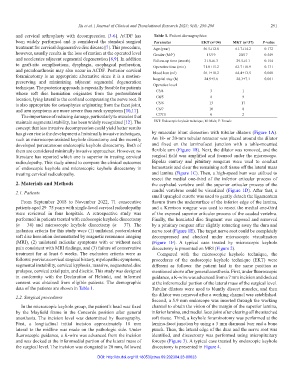
        been widely performed and is considered the standard surgical   Parameter    EKT (n=34)   MKT (n=37)   P‑value
        treatment for cervical degenerative disc disease [7]. This procedure,   Age (year)  56.5±12.8  61.7±14.2  0.172
        however, usually results in the loss of motion at the operated level   Gender (M/F)  15/19   20/17     0.549
        and accelerates adjacent segmental degeneration [8,9]. In addition   Follow-up time (month)  31.8±6.3  29.5±5.1  0.154
        to graft-site complications, dysphagia, esophageal perforation,   Operative time (min)  71.0±15.2  63.7±18.9  0.131
        and pseudoarthrosis may also occur in ACDF. Posterior cervical   blood loss (ml)  56.1±18.2  64.4±13.5  0.068
        foraminotomy is an appropriate alternative since it is a motion-  hospital stay (h)  24.9±5.6  28.3±7.1  0.061
        preserving  and  minimizing  adjacent  segmental  degeneration   Operative level
        technique. The posterior approach is especially feasible for patients
        whose soft disc herniation originates from the posterolateral   C3/4             3            1
        location, lying lateral to the cord and compressing the nerve root. It   C4/5    8            9
        is also appropriate for osteophytes originating from the facet joint,   C5/6    13            17
        and arm symptoms are more severe than neck symptoms [10,11].  C6/7              10            8
          The importance of reducing damage, particularly to muscles that   C7/T1        0            2
        maintain segmental stability, has been widely recognized [12]. The   EKT: Endoscopic keyhole technique; M: Male; F: Female
        concept that less invasive decompression could yield better results
        has given rise to the development of minimally invasive techniques,   by muscular blunt dissection with tubular dilators (Figure 1A).
        such as microscope-assisted keyhole discectomy and the recently   An 18- or 20-mm tubular retractor was placed around the dilator
        developed percutaneous endoscopic keyhole discectomy. Both of   and  fixed  on  the  laminofacet  junction  with  a  table-mounted
        them are considered minimally invasive approaches. However, no   flexible arm (Figure 1B). Next, the dilator was removed, and the
        literature has reported which one is superior in treating cervical   surgical field was amplified and focused under the microscope.
        radiculopathy. This study aimed to compare the clinical outcomes   Bipolar  cautery  and pituitary  rongeurs were used to conduct
        of endoscopic  keyhole  and  microscopic  keyhole  discectomy  in   hemostasis and clear the remaining soft tissue off the lateral mass
        treating cervical radiculopathy.                        and lamina (Figure 1C). Then, a high-speed burr was utilized to
                                                                resect the medial one-third of the inferior articular  process of
        2. Materials and Methods                                the cephalad vertebra until the superior articular process of the
        2.1. Patients                                           caudal  vertebrae  could  be  visualized  (Figure  1D). After that, a
                                                                small upangled curette was used to gently detach the ligamentum
          From  September  2018  to  November  2022,  71  consecutive   flavum from the undersurface of the inferior edge of the lamina,
        patients aged 29–75 years with single-level cervical radiculopathy   and a Kerrison rongeur was used to resect the medial one-third
        were  reviewed  in  four hospitals.  A  retrospective  study was   of the exposed superior articular process of the caudad vertebra.
        performed in patients treated with endoscopic keyhole discectomy   Finally, the  herniated  disc  fragment  was exposed  and  removed
        (n = 34) and microscopic keyhole discectomy  (n  =  37).  The   by a pituitary rongeur after slightly retracting away the dura and
        inclusion criteria for this study were (1) unilateral posterolateral   nerve root (Figure 1E). The target nerve root could be completely
        soft disc herniation demonstrated by magnetic resonance imaging   decompressed  and  checked  under  microscopic  visualization
        (MRI), (2) unilateral  radicular  symptoms with or without neck   (Figure  1F).  A  typical  case  treated  by microscopic  keyhole
        pain consistent with MRI findings, and (3) failure of conservative   discectomy is presented on MRI (Figure 2).
        treatment  for  at  least  6  weeks.  The  exclusion  criteria  were  as   Compared with the microscopic keyhole technique,  the
        follows: previous cervical surgical history, myelopathic symptoms,   procedures of the endoscopic keyhole technique  (EKT) were
        segmental instability, cervical kyphosis, massive, sequestered disc   different  as  follows:  the  patient  laid  in  the  same  position  as
        prolapse, cervical axial pain, and discitis. This study was designed   mentioned above after general anesthesia. First, under fluoroscopic
        in conformity  with the  Declaration  of Helsinki,  and informed   guidance, a K-wire was advanced from a 7 mm incision and docked
        consent was obtained  from eligible  patients.  The demographic   at the inferomedial portion of the lateral mass of the surgical level.
        data of the patients are shown in Table 1.              Tubular dilators were used to bluntly dissect muscles, and then
                                                                the dilator was removed after a working channel was established.
        2.2. Surgical procedures
                                                                Second, a 5.9 mm endoscope was inserted through the working
          In the microscopic keyhole group, the patient’s head was fixed   channel to obtain the vision of the margin of the superior lamina,
        by  the  Mayfield  frame  in  the  Concorde  position  after  general   inferior lamina, and medial facet joint after clearing off the attached
        anesthesia. The incision level was determined by fluorography.   soft tissue. Third, a keyhole foraminotomy was performed at the
        First,  a  longitudinal  initial  incision  approximately  10  mm   lamina-facet junction by using a 3 mm diamond burr and a bone
        lateral  to the midline was made on the pathologic  side. Under   punch. Then, the lateral edge of the dura and the nerve root was
        fluoroscopic guidance, a K-wire was advanced from the incision   identified,  and  discectomy  was  performed  using  micropituitary
        and was docked at the inferomedial portion of the lateral mass of   forceps (Figure 3). A typical case treated by endoscopic keyhole
        the surgical level. The incision was elongated to 20 mm, followed   discectomy is presented in Figure 4.
                                          DOI: http://dx.doi.org/10.18053/jctres.09.202304.23-00023

