


Page 77 - JCTR-9-4
P. 77
Xu et al. | Journal of Clinical and Translational Research 2023; 9(4): 290-296   293

          A                       B


          C


                                  D


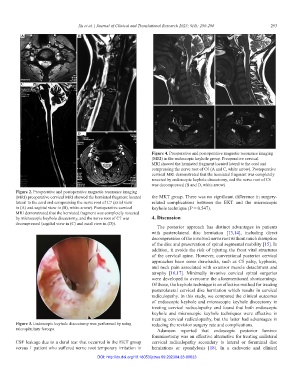
                                                                Figure 4. Preoperative and postoperative magnetic resonance imaging
                                                                (MRI) in the endoscopic keyhole group. Preoperative cervical
                                                                MRI showed the herniated fragment located lateral to the cord and
                                                                compressing the nerve root of C6 (A and C, white arrow). Postoperative
                                                                cervical MRI demonstrated that the herniated fragment was completely
                                                                resected by endoscopic keyhole discectomy, and the nerve root of C6
                                                                was decompressed (B and D, white arrow).
        Figure 2. Preoperative and postoperative magnetic resonance imaging
        (MRI) preoperative cervical MRI showed the herniated fragment located   the MKT group. There was no significant difference in surgery-
        lateral to the cord and compressing the nerve root of C7 (axial view   related  complications between the EKT and the microscopic
        in (A) and sagittal view in (B), white arrow). Postoperative cervical   keyhole technique (P = 0.547).
        MRI demonstrated that the herniated fragment was completely resected
        by microscopic keyhole discectomy, and the nerve root of C7 was   4. Discussion
        decompressed (sagittal view in (C) and axial view in (D)).
                                                                   The posterior approach has distinct advantages in patients
                                                                with  posterolateral  disc  herniation  [13,14], including  direct
                                                                decompression of the involved nerve root without much disruption
                                                                of the disc and preservation of spinal segmental mobility [15]. In
                                                                addition, it avoids the risk of injuring the front vital structures
                                                                of the  cervical  spine. However, conventional  posterior  cervical
                                                                approaches  have  some  drawbacks,  such  as  C5  palsy,  kyphosis,
                                                                and neck pain associated with extensor muscle detachment and
                                                                atrophy  [16,17]. Minimally  invasive  cervical  spinal  surgeries
                                                                were developed to overcome the aforementioned shortcomings.
                                                                Of those, the keyhole technique is an effective method for treating
                                                                posterolateral  cervical  disc herniation  which results in cervical
                                                                radiculopathy. In this study, we compared the clinical outcomes
                                                                of endoscopic  keyhole  and  microscopic  keyhole  discectomy  in
                                                                treating  cervical  radiculopathy  and found that  both  endoscopic
                                                                keyhole  and  microscopic  keyhole  techniques  were  effective  in
                                                                treating cervical radiculopathy, but the latter had advantages in
        Figure 3. Endoscopic keyhole discectomy was performed by using   reducing the revision surgery rate and complications.
        micropituitary forceps.                                    Adamson reported  that  endoscopic  posterior  lamino-
                                                                foraminotomy was an effective alternative for treating unilateral
        CSF leakage due to a dural tear that occurred in the EKT group   cervical  radiculopathy secondary to lateral  or foraminal  disc
        versus 1 patient who suffered nerve root temporary irritation in   herniations  or spondylosis [18]. In a cadaveric  and clinical
                                          DOI: http://dx.doi.org/10.18053/jctres.09.202304.23-00023

