


Page 78 - JCTR-9-4
P. 78
294                       Xu et al. | Journal of Clinical and Translational Research 2023; 9(4): 290-296
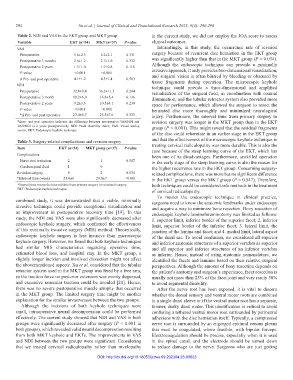
        Table 2. NDI and VAS in the EKT group and MKT group     in the current study, we did not employ the JOA score to assess
        Variable              EKT (n=34)  MKT (n=37)  P‑value   clinical outcomes.
        VAS                                                        Interestingly,  in  this  study,  the  occurrence  rate  of  revision
         Preoperative           5.6±2.3    6.2±2.1    0.331     surgery because  of recurrent  disc herniation  in the EKT group
         Postoperative 3 months  2.4±1.2   2.7±1.0    0.332     was significantly higher than that in the MKT group (P = 0.034).
         Postoperative 2 years  1.5±1.0    1.9±0.8    0.118     Although the endoscopic technique can provide a minimally
         P-value                <0.001     <0.001               invasive approach, it only provides two-dimensional visualization,
         Δ Pre- and post operative  4.1±1.2  4.3±1.4  0.583     and surgical vision is often blurred by bleeding or obscured by
                                                                tissue fragments during operation.  The microscopic  keyhole
        NDI                                                     technique  could  provide  a  three-dimensional  and  amplified
         Preoperative           32.8±9.4  36.2±11.3   0.244     visualization  of  the  surgical  field,  in  coordination  with  coaxial
         Postoperative 3 month  19.2±6.0   16.8±5.4   0.136     illumination, and the tubular retractor system also provided more
         Postoperative 2 years  9.2±3.6    10.5±4.1   0.230     space for performance, which allowed the surgeon to resect the
         P-value                <0.001     <0.001               herniated  disc  more  thoroughly  and  minimized  neurological
         *Δ Pre- and post operative  23.4±5.7  25.3±7.6  0.313  injury. Furthermore,  the interval  time  from primary  surgery to
        *Δpre-  and  post  operative  indicates  the  difference  between  preoperative  VAS/NDI  and   revision surgery was longer in the MKT group than in the EKT
        VAS/NDI  at  2  years  postoperatively.  NDI:  Neck  disability  index;  VAS:  Visual  analog   group (P < 0.001). This might reveal that the residual fragments
        scores; EKT: Endoscopic keyhole technique
                                                                of the disc could reherniate in an earlier stage in the EKT group
        Table 3. Surgery-related complications and revision surgery  and that the effectiveness of the microscopic keyhole technique in
        Item              EKT (n=34)  MKT group (n=37)  P‑value  treating cervical radiculopathy was more durable. This is also the
                                                                case because of the steep learning curve of the EKT, which has
        Complications                                           been one of its disadvantages. Furthermore, unskilled operation
         Nerve root irritation  2          1          0.547     in the early stage of the steep learning curve is also the reason for
         Cerebrospinal fluid  1            0                    the higher recurrence rate in the EKT group. Concerning surgery-
        Revision surgery     9             2          0.034     related complications, there was more but no significant difference
        *Interval time (week)  21.0±6    29.0±7      <0.001     in the EKT group versus the MKT group (P = 0.547). Therefore,
        *Interval time means the interval time from primary surgery to revisional surgery.   both techniques could be considered safe methods in the treatment
        EKT: Endoscopic keyhole technique
                                                                of cervical radiculopathy.
                                                                   To master  the  endoscopic  technique  in  clinical  practice,
        combined study, it was demonstrated that a viable, minimally   surgeons need to know the anatomic landmarks under endoscopy
        invasive  technique  could  provide  exceptional  visualization  and   and acquire a way to minimize bone resection. Bony resection of
        an improvement  in postoperative  recovery time [19]. In this   endoscopic keyhole laminoforaminotomy was limited as follows:
        study, the NDI and VAS were also significantly decreased after   1. superior limit, inferior border of the superior facet; 2. inferior
        endoscopic  keyhole  surgery,  which  confirmed  the  effectiveness   limit,  superior  border  of  the  inferior  facet;  3.  lateral  limit,  the
        of this minimally invasive surgery (MIS) method. Theoretically,   junction of the lamina and facet; and 4. medial limit, lateral aspect
        endoscopic keyhole surgery is less invasive than microscopic   of the dural sac. To avoid confusion, we considered all superior
        keyhole surgery. However, we found that both keyhole techniques   and inferior anatomic structures of a superior vertebra as superior
        had similar MIS characteristics  regarding operative  time,   and all superior and inferior structures of an inferior vertebra
        estimated  blood loss, and hospital stay. In the MKT group, a   as inferior. Hence, instead of using anatomic nomenclature, we
        slightly longer incision and involved dissection might not affect   identified the facets and laminae based on their relative surgical
        the abovementioned aspects. Xu et al. considered that the tubular   perspectives. Although the amount of bony resection depends on
        retractor system used in the MKT group was fixed by a free arm,   the patient’s anatomy and surgeon’s experience, facet resection is
        so the traction force on posterior extensors was evenly dispersed,   usually not more than 25% of the facet joint and very rarely 50%
        and excessive muscular traction could be avoided [20]. Hence,   to avoid segmental disability.
        there was no severe postoperative muscle atrophy that occurred   After the nerve root has been exposed, it is vital  to discern
        in the MKT group. The limited  surgery time  might  be another   whether the dorsal sensory and ventral motor roots are combined
        explanation for the similar invasiveness between the two groups.  in a single dural sleeve or if the ventral motor root has a separate,
          Although the incisions of both keyhole  techniques  were   thinner, dusky dural mater. This identification is critical to avoid
        small,  intraoperative neural  decompression  could  be  performed   confusing a tethered ventral motor root surrounded by perineural
        effectively. The current study showed that NDI and VAS in both   adhesions with the disc herniation itself. Typically, a compressed
        groups were significantly decreased after surgery (P < 0.001 in   nerve root is surrounded by an engorged epidural venous plexus
        both groups), which revealed valid neural decompression resulting   that must be coagulated,  where feasible,  with bipolar forceps.
        from both MKT keyhole and EKTs. The improvements in VAS   Electrocoagulation should be precise, especially when it is used
        and NDI between the two groups were significant. Considering   in  the  spinal  canal,  and  the  electrode  should  be  turned  down
        that  we treated  cervical  radiculopathy  rather  than  myelopathy   to reduce damage  to the nerve. Surgeons who are  just getting
                                          DOI: http://dx.doi.org/10.18053/jctres.09.202304.23-00023

