


Page 83 - JCTR-9-4
P. 83
Ali et al. | Journal of Clinical and Translational Research 2023; 9(4): 297-307   299
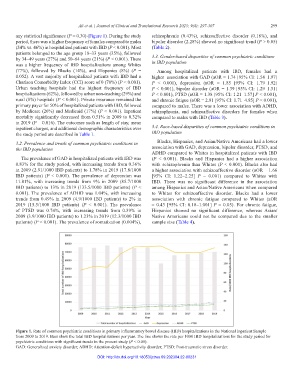
        any statistical significance (P = 0.30) (Figure 1). During the study   schizophrenia  (0.43%),  schizoaffective  disorder  (0.18%),  and
        period, there was a higher frequency of females compared to males   bipolar disorder (2.28%) showed no significant trend (P > 0.05)
        (54% vs. 46%) in hospitalized patients with IBD (P < 0.001). Most   (Table 2).
        patients belonged to the age group 18–33 years (35%), followed
        by 34–49 years (27%) and 50–64 years (21%) (P < 0.001). There   3.3. Gender-based disparities of common psychiatric conditions
        was  a  higher  frequency  of  IBD  hospitalizations  among Whites   in IBD population
        (77%),  followed  by  Blacks  (14%),  and  Hispanics  (8%)  (P  =   Among  hospitalized  patients  with  IBD,  females  had  a
        0.052). A vast majority of hospitalized patients with IBD had a   higher  association with GAD (aOR = 1.74 [95% CI: 1.54–1.97]
        Charlson Comorbidity Index (CCI) score of 0 (70%) (P < 0.001).   P  <  0.001),  depression  (aOR  =  1.85  [95%  CI:  1.79–1.92]
        Urban  teaching  hospitals  had  the  highest  frequency  of  IBD   P < 0.001), bipolar disorder (aOR = 1.39 [95% CI: 1.29–1.51]
        hospitalizations (62%), followed by urban non-teaching (29%) and   P < 0.001), PTSD (aOR = 1.38 [95% CI: 1.21–1.57] P < 0.001),
        rural (8%) hospitals (P < 0.001). Private insurance remained the   and chronic fatigue (aOR = 2.91 [95% CI: 1.71–4.95] P < 0.001),
        primary payer for 50% of hospitalized patients with IBD, followed   compared to males. There was a lower association with ADHD,
        by Medicare (26%) and Medicaid (17%) (P < 0.001). Inpatient   schizophrenia,  and  schizoaffective  disorders  for  females  when
        mortality significantly decreased from 0.51% in 2009 to 0.32%   compared to males with IBD (Table 3).
        in 2019 (P = 0.016). The outcomes such as length of stay, mean
        inpatient charges, and additional demographic characteristics over   3.4. Race-based disparities of common psychiatric conditions in
        the study period are described in Table 1.              IBD population
        3.2. Prevalence and trends of common psychiatric conditions in   Blacks, Hispanics, and Asian/Native Americans had a lower
        the IBD population                                      association with GAD, depression, bipolar disorder, PTSD, and
                                                                ADHD compared to Whites in hospitalized patients with IBD
          The prevalence of GAD in hospitalized patients with IBD was   (P  <  0.001).  Blacks  and  Hispanics  had  a  higher  association
        0.83% for the study period, with increasing trends from 0.36%   with schizophrenia than Whites (P < 0.001). Blacks also had
        in 2009 (2.91/1000 IBD patients) to 1.78% in 2019 (17.8/1000   a higher association with schizoaffective disorder (aOR = 1.66
        IBD  patients)  (P  <  0.001). The  prevalence  of  depression  was   [95%  CI:  1.22–2.25]  P  =  0.001)  compared  to  Whites  with
        11.81%,  with  increasing  trends  from  9%  in  2009  (85.7/1000   IBD.  There  was  no  significant  difference  in  the  association
        IBD patients) to 13% in 2019 (133.5/1000 IBD patients) (P <   among Hispanics and Asian/Native Americans when compared
        0.001). The prevalence of ADHD was 1.04%, with increasing   to  Whites  for  schizoaffective  disorder.  Blacks  had  a  lower
        trends  from  0.49%  in  2009  (4.9/1000  IBD  patients)  to  2%  in   association  with  chronic  fatigue  compared  to  Whites  (aOR
        2019  (15.5/1000  IBD  patients)  (P  <  0.001).  The  prevalence   = 0.43 [95% CI: 0.18–1.001] P = 0.05). For chronic fatigue,
        of  PTSD  was  0.74%,  with  increasing  trends  from  0.39%  in   Hispanics  showed  no  significant  difference,  whereas  Asian/
        2009 (3.9/1000 IBD patients) to 1.23% in 2019 (12.3/1000 IBD   Native Americans  could  not  be  compared  due  to  the  smaller
        patients) (P < 0.001). The prevalence of somatization (0.004%),   sample size (Table 4).


        Figure 1. Rate of common psychiatric conditions in primary inflammatory bowel disease (IBD) hospitalizations in the National Inpatient Sample
        from 2009 to 2019. Bars show the total IBD hospitalizations per year. The line shows the rate per 1000 IBD hospitalizations for the study period for
        psychiatric conditions with significant trends in the present study (P < 0.05).
        GAD: Generalized anxiety disorder; ADHD: Attention-deficit hyperactivity disorder; PTSD: Post-traumatic stress disorder.
                                          DOI: http://dx.doi.org/10.18053/jctres.09.202304.22-00231

