


Page 86 - JCTR-9-4
P. 86
302                       Ali et al. | Journal of Clinical and Translational Research 2023; 9(4): 297-307
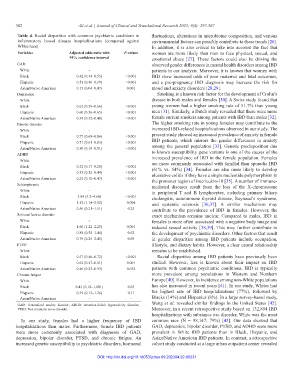
        Table 4.  Racial  disparities  with  common  psychiatric  conditions  in   fluctuations, alterations in microbiome composition, and various
        inflammatory  bowel  disease  hospitalizations  (compared  against   environmental factors can possibly contribute to these trends [26].
        White race)                                             In  addition,  it  is  also  critical  to  take  into  account  the  fact  that
        Variables             Adjusted odds ratio with   P-values  women are more likely than men to face physical, sexual, and
                              95% confidence interval           emotional  abuse  [27].  These  factors  could  also  be  driving  the
        GAD                                                     observed gender differences in mental health disorders among IBD
         White                        -                         patients in our analysis. Moreover, it is known that women with
         Black                   0.42 (0.34–0.53)    <0.001     IBD show increased odds of poor maternal and fetal outcomes,
         Hispanic                0.53 (0.40–0.69)    <0.001     and  a  pre-pregnancy  IBD  diagnosis  may  increase  the  risk  for
         Asian/Native American   0.15 (0.04–0.47)     0.001     mood and anxiety disorders [28,29].
        Depression                                                 Smoking is a known risk factor for the development of Crohn’s
         White                        -                         disease in both males and females [30]. A Swiss study found that
         Black                   0.62 (0.59–0.66)    <0.001     young women had a higher smoking rate of 51.7% than young
         Hispanic                0.60 (0.56–0.65)    <0.001     men [31]. Similarly, a Dutch study revealed that there were more
         Asian/Native American   0.39 (0.32–0.48)    <0.001     female current smokers among patients with IBD than males [32].
        Bipolar disorder                                        The higher smoking rate in young females may contribute to the
         White                        -                         increased IBD-related hospitalizations observed in our study. The
         Black                   0.77 (0.68–0.86)    <0.001     present study showed an increased prevalence of anxiety in female
         Hispanic                0.71 (0.61–0.83)    <0.001     IBD  patients,  which  mirrors  the  gender  differences  in  anxiety
         Asian/Native American   0.30 (0.18–0.51)    <0.001     among  the  general  population  [33].  Genetic  predisposition  due
        ADHD                                                    to known susceptibility gene variants is one of the causes of the
         White                        -                         increased prevalence of IBD in the female population. Females
                                                                are more commonly associated with familial than sporadic IBD
         Black                   0.22 (0.17–0.28)    <0.001     (61%  vs.  54%)  [34].  Females  are  also  more  likely  to  develop
         Hispanic                0.33 (0.25–0.44)    <0.001     ulcerative colitis if they have a single nucleotide polymorphism in
         Asian/Native American   0.22 (0.10–0.47)    <0.001     the promoter region of interleukin-10 [35]. A number of immune-
        Schizophrenia                                           mediated  diseases  result  from  the  loss  of  the  X-chromosome
         White                        -                         in  peripheral  T  and  B  lymphocytes,  including  primary  biliary
         Black                   3.84 (3.2–4.60)     <0.001     cholangitis,  autoimmune  thyroid  disease,  Raynaud’s  syndrome,
         Hispanic                1.52 (1.14–2.02)     0.004     and  systemic  sclerosis  [36,37].  A  similar  mechanism  may
         Asian/Native American   0.56 (0.21–1.51)     0.25      contribute  to  the  prevalence  of  IBD  in  females.  However,  the
        Schizoaffective disorder                                exact  mechanism  remains  unclear.  Compared  to  males,  IBD  in
         White                        -                         females is more often associated with a negative body image and
         Black                   1.66 (1.22–2.25)     0.001     reduced  sexual  activity  [38,39]. This  may  further  contribute  to
         Hispanic                0.88 (0.54–1.44)     0.62      the development of psychiatric disorders. Other factors that result
         Asian/Native American   0.79 (0.25–2.45)     0.69      in  gender  disparities  among  IBD  patients  include  occupation,
        PTSD                                                    lifestyle, and dietary habits. However, a clear causal relationship
         White                                                  remains to be established.
         Black                   0.57 (0.46–0.72)    <0.001        Racial  disparities  among  IBD  patients  have  previously  been
         Hispanic                0.62 (0.47–0.81)     0.001     studied.  However,  less  is  known  about  their  impact  on  IBD
         Asian/Native American   0.46 (0.23–0.93)     0.032     patients  with  common  psychiatric  conditions.  IBD  is  typically
        Chronic fatigue                                         more  prevalent  among  populations  in  Western  and  Northern
         White                        -                         Europe [40]. However, its incidence among non-White populations
         Black                   0.43 (0.18–1.001)    0.05      has also increased in recent years [41]. In our study, Whites had
         Hispanic                0.39 (0.12–1.26)     0.11      the  highest  rate  of  IBD  hospitalizations  (77%),  followed  by
         Asian/Native American        -                -        Blacks (14%) and Hispanics (8%). In a large survey-based study,
        GAD:  Generalized  anxiety  disorder;  ADHD:  Attention-deficit  hyperactivity  disorder;   Wang et al. revealed similar findings in the United States [42].
        PTSD: Post-traumatic stress disorder.                   Moreover, in a recent retrospective study based on 132,894 IBD
                                                                hospitalizations with substance use disorder, White was the most
          In  our  study,  females  had  a  higher  frequency  of  IBD   common  race  (N  =  98,147;  79%)  [43].  Our  data  showed  that
        hospitalizations  than  males.  Furthermore,  female  IBD  patients   GAD, depression, bipolar disorder, PTSD, and ADHD were more
        were  more  commonly  associated  with  diagnoses  of  GAD,   prevalent  in  White  IBD  patients  than  in  Black,  Hispanic,  and
        depression,  bipolar  disorder,  PTSD,  and  chronic  fatigue.  An   Asian/Native American IBD patients. In contrast, a retrospective
        increased genetic susceptibility to psychiatric disorders, hormonal   cohort study conducted at a large urban outpatient center revealed

                                          DOI: http://dx.doi.org/10.18053/jctres.09.202304.22-00231

