


Page 85 - JCTR-9-4
P. 85
Ali et al. | Journal of Clinical and Translational Research 2023; 9(4): 297-307   301
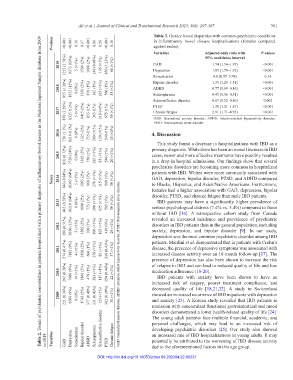
                                                                 Table 3. Gender-based disparities with common psychiatric conditions
                  Table 2. Trends of psychiatric comorbidities in patients hospitalized with a primary diagnosis of inflammatory bowel disease in the National Inpatient Sample database from 2009
                       P-values  <0.001  <0.001  0.31  0.37  <0.001  0.90  0.56  <0.001  0.16  in  inflammatory  bowel  disease  hospitalizations  (females  compared
                                                                 against males)
                                                                 Variables            Adjusted odds ratio with   P-values
                                                                                       95% confidence interval
                          2019  1255 (1.78%)  9375 (13%)  5 (<1%)  1590 (2%)  1090 (2%)  340 (0.48%)  145 (<1%)  870 (1.23%)  60 (<1%)  GAD  1.74 (1.54–1.97)  <0.001
                                                                                          1.85 (1.79–1.92)
                                                                                                               <0.001
                                                                 Depression
                                                                                          4.8 (0.57–3.98)
                                                                                                                0.14
                                                                 Somatization             1.39 (1.29–1.51)     <0.001
                                                                 Bipolar disorder
                          2018  955 (1.38%)  8555 (12%)  0 (0%)  1350 (2%)  870 (1%)  365 (1%)  165 (<1%)  700 (1%)  55 (<1%)  ADHD  0.77 (0.69–0.86)  <0.001
                                                                                          0.43 (0.36–0.51)
                                                                 Schizophrenia
                                                                                                               <0.001
                                                                 Schizoaffective disorder  0.67 (0.52–0.86)    0.002
                          2017  870 (1.29%)  8325 (12%)  5 (<1%)  1415 (2%)  855 (1%)  365 (1%)  210 (<1%)  675 (1%)  55 (<1%)  PTSD  1.38 (1.21–1.57)  <0.001
                                                                 Chronic fatigue
                                                                                                               <0.001
                                                                                          2.91 (1.71–4.95)
                                                                 GAD:  Generalized  anxiety  disorder;  ADHD:  Attention-deficit  hyperactivity  disorder;
                                                                 PTSD: Post-traumatic stress disorder
                          2016  720 (1.1%)  8219 (12%)  0 (0%)  1325 (2%)  755 (1%)  290 (<1%)  120 (<1%)  540 (1%)  35 (<1%)  4. Discussion
                                                                   This study found a decrease in hospitalizations with IBD as a
                                                                primary diagnosis. While there has been an overall increase in IBD
                          2015  410 (0.72%)  7720 (14%)  0 (0%)  1365 (2%)  750 (1%)  265 (<1%)  85 (<1%)  540 (1%)  20 (<1%)  cases, newer and more effective treatments have possibly resulted
                                                                in a drop in hospital admissions. Our findings show that several
                                                                psychiatric disorders are becoming more common in hospitalized
                                                                patients with IBD. Whites were more commonly associated with
                       Years  2014  640 (0.84%)  10365 (14%)  5 (<1%)  1865 (2%)  960 (1%)  270 (<1%)  115 (<1%)  560 (1%)  50 (<1%)  GAD, depression, bipolar disorder, PTSD, and ADHD compared
                                                                to Blacks, Hispanics, and Asian/Native Americans. Furthermore,
                                                   GAD: Generalized anxiety disorder; ADHD: Attention-deficit hyperactivity disorder; PTSD: Post-traumatic stress disorder.
                                                                females had a higher association with GAD, depression, bipolar
                                                                disorder, PTSD, and chronic fatigue than male IBD patients.
                                                                   IBD  patients  may  have  a  significantly  higher  prevalence  of
                          2013  445 (0.59%)  10210 (14%)  0 (0%)  1690 (2%)  775 (1%)  300 (<1%)  125 (<1%)  505 (1%)  50 (<1%)  serious psychological distress (7.4% vs. 3.4%) compared to those
                                                                without  IBD  [16].  A  retrospective  cohort  study  from  Canada

                                                                disorders in IBD patients than in the general population, including
                          2012  390 (0.51%)  9160 (12%)  5 (<1%)  1895 (2%)  700 (1%)  300 (<1%)  165 (<1%)  430 (0%)  29 (<1%)  revealed  an  increased  incidence  and  prevalence  of  psychiatric
                                                                anxiety,  depression,  and  bipolar  disorder  [9].  In  our  study,
                                                                depression was the most common psychiatric disorder among IBD
                            374 (0.47%)  7182 (9%)  1826 (2%)  606 (1%)  336 (0.43%)  patients. Mardini et al. demonstrated that in patients with Crohn’s
                                                                disease, the presence of depressive symptoms was associated with
                          2011   4 (<1%)  278 (<1%)  82 (<1%)  37 (<1%)  increased disease activity over an 18-month follow-up [17]. The
                                                                presence of depression has also been shown to increase the risk
                                                                of relapse in IBD and can lead to reduced quality of life and low
                          2010  292 (0.38%)  7060 (9%)  10 (<1%)  1860 (2%)  479 (1%)  283 (<1%)  117 (<1%)  350 (0.46%)  22 (<1%)  medication adherence [18-20].
                                                                   IBD  patients  with  anxiety  have  been  shown  to  have  an
                                                                increased  risk  of  surgery,  poorer  treatment  compliance,  and
                                                                decreased  quality  of  life  [18,21,22].  A  study  in  Switzerland
                          2009  221 (0.36%)  6500 (9%)  0 (0%)  1748 (2%)  377 (0.49%)  331 (0.43%)  123 (<1%)  302 (0.39%)  30 (<1%)  showed an increased recurrence of IBD in patients with depression
                                                                and anxiety [23]. A Korean study revealed that IBD patients in
                                                                remission with concomitant functional gastrointestinal and mood
                                                                disorders demonstrated a lower health-related quality of life [24].
                                                                The young adult patients face multiple financial, academic, and

                                                                developing  psychiatric  disorders  [25].  Our  study  also  showed
                                                                an increased rate of IBD hospitalizations in young adults. It may
                    to 2019  Variables  GAD  Depression  Somatization   Bipolar disorder  ADHD  Schizophrenia  Schizoaffective disorder  PTSD  Chronic fatigue  personal  challenges,  which  may  lead  to  an  increased  risk  of
                                                                potentially be attributed to the worsening of IBD disease activity
                                                                due to the aforementioned factors in this age group.
                                          DOI: http://dx.doi.org/10.18053/jctres.09.202304.22-00231

