


Page 37 - JCTR-9-6
P. 37
Asekenye et al. | Journal of Clinical and Translational Research 2023; 9(6): 398-413   401
        The households were, then, sampled using “spinning the bottle”   4. Results
        method  and  a  person  responsible  for  meal  preparation  from
        each  selected  household  was  interviewed.  Cochran’s  (1972)   4.1. Demographic characteristics of participants
        formula for finite population was used to calculate the sample   Results  of  the  demographic  characteristics  of  participants  in
        size, that is,                                          this study are summarized  in  Table  1.  Out  of  the  422  eligible
                                                                respondents  who  participated  in  the  study,  all  were  female
                                   2
                                   t pq                         (persons responsible for meal preparation) and from the sampled
                               n =
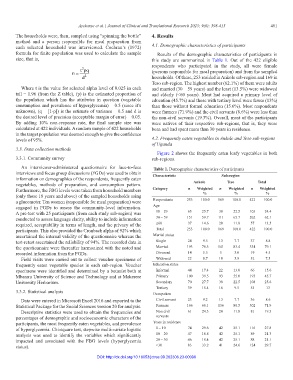
                                   d 2                          households. Of these, 253 resided in Ankole sub-region and 169 in
                                                                Teso sub-region. The highest number (62.1%) of them were adults
          Where t is the value for selected alpha level of 0.025 in each   and married (30 – 59 years) and the least (13.5%) were widowed
        tail = 1.96 (from the Z table), (p) is the estimated proportion of   and  elderly  (<60  years).  Most  had  acquired  a  primary  level  of
        the  population  which  has  the  attributes  in  question  (vegetable   education (45.7%) and those with tertiary level were fewer (13%)
        consumption and prevalence of hyperglycemia) = 0.5 (since it’s   than those without formal education (15.6%). Most respondents
        unknown), (q = [1-p]) is the estimate of variance = 0.5 and d is   were farmers (71.9%) and the civil servants (8.6%) were less than
        the desired level of precision (acceptable margin of error) = 0.05.   the non-civil servants (19.3%). Overall, most of the participants
        By  adding  10%  non-response  rate,  the  final  sample  size  was   were  natives  of  their  respective  sub-regions,  that  is,  they  were
        calculated at 422 individuals. A random sample of 422 households   born and had spent more than 30 years in residence.
        in the target population was deemed enough to give the confidence
        levels of 95%.                                          4.2. Frequently eaten vegetables in Ankole and Teso sub-regions
                                                                of Uganda
        3.3. Data collection methods
                                                                   Figure 2 shows the frequently eaten leafy vegetables in both
        3.3.1. Community survey                                 sub-regions.

          An  interviewer-administered  questionnaire  for  face-to-face   Table 1. Demographic characteristics of participants
        interviews and focus group discussions (FGDs) was used to obtain   Characteristic     Sub‑region
        information on demographics of the respondents, frequently eaten
        vegetables,  methods  of  preparation,  and  consumption  pattern.        Ankole        Teso         Total
        Furthermore, the FBG levels were taken from household members   Category  n  Weighted   n  Weighted   n  Weighted
                                                                                      %
                                                                                                                %
                                                                                                   %
        (only those 18 years and above) of the sampled households using
        a glucometer. Ten women (responsible for meal preparation) were   Respondents  253  100.0  169  100.0  422  100.0
        engaged  in  FGDs  to  assess  the  community-level  information.   Age
        A pre-test with 25 participants (from each study sub-region) was   18 – 29  65  25.7  38  22.5   103    24.4
        conducted to assess language clarity, ability to include information   30 – 59  151  59.7  111  65.7  262  62.1
        required, acceptability in terms of length, and the privacy of the   ≥60  37  14.6  20     11.8   57    13.5
        participants. This also provided the Cronbach alpha of 92% which   Total  253  100.0  169  100.0  422  100.0
        ascertained the internal validity of the questionnaire whereas the   Marital status
        test-retest ascertained the reliability of 94%. The recorded data in   Single  24  9.5  13  7.7   37    8.8
        the questionnaire were thereafter harmonized with the noted and   Married  193  76.3  141  83.4  334    79.1
        recorded information from the FGDs.                       Divorced     14     5.5    5     3.0    19    4.5
          Field visits were carried out to collect voucher specimens of   Widowed  22  8.7  10     5.9    32    7.5
        frequently  eaten  vegetable  species  in  each  sub-region. Voucher   Education status
        specimens were identified and determined by a botanist both at   Informal  44  17.4  22   13.0    66    15.6
        Mbarara University of Science and Technology and at Makerere   Primary  100  39.5   93    55.0   193    45.7
        University Herbarium.                                     Secondary    70    27.7   38    22.5   108    25.6
                                                                  Tertiary     39    15.4   16     9.5    55    13
        3.3.2. Statistical analysis                              Occupation

          Data were entered in Microsoft Excel 2016 and exported to the   Civil servant  23  9.2  13  7.7  36   8.6
        Statistical Package for the Social Sciences version 20 for analysis.  Farmers  166  66.1  136  80.5  302  71.9
          Descriptive statistics were used to obtain the frequencies and   Non civil   61  24.3  20  11.8  81   19.3
        percentages of demographic and socioeconomic characters of the   servants
        participants, the most frequently eaten vegetables, and prevalence   Years in residence
        of hyperglycemia. Chi-square test, stepwise multi-variate logistic   0 – 10  74  29.6  42  25.1  116    27.8
        analysis  was  used  to  identify  the  variables  which  significantly   10 – 20  47  18.8  42  25.1  89  21.3
        impacted  and  associated  with  the  FBG levels  (hyperglycemia   20 – 30  46  18.4  42  25.1    88    21.1
        status).                                                  >30          83    33.2   41    24.6   124    29.7
                                          DOI: http://dx.doi.org/10.18053/jctres.09.202306.23-00096

