


Page 38 - JCTR-9-6
P. 38
402                       Asekenye et al. | Journal of Clinical and Translational Research 2023; 9(6): 398-413
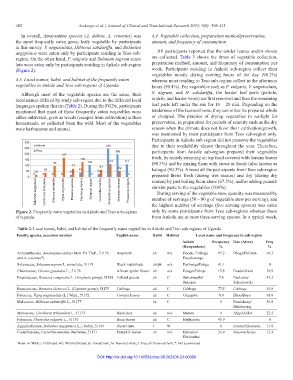
          In overall, Amaranthus species (A. dubius, A. cruentus) was   4.4. Vegetable collection, preparation method/preservation,
        the most frequently eaten green leafy vegetable by participants   amount, and frequency of consumption
        in this survey. V. unguiculata, Hibiscus sabdariffa, and Balanites
        aegyptiaca were eaten only by participants residing in Teso sub-  All participants reported that the tender leaves and/or shoots
        region. On the other hand, P. vulgaris and Solanum nigrum sensu   are  collected. Table  3  shows  the  times  of  vegetable  collection,
        lato were eaten only by participants residing in Ankole sub-region   preparation method, amount, and frequency of consumption per
        (Figure 2).                                             week. Participants residing  in  Ankole sub-region collect  their
                                                                vegetables  mostly  during  evening  hours  of  the  day  (96.2%)
        4.3. Local names, habit, and habitat of the frequently eaten   whereas most residing in Teso sub-region collect in the afternoon
        vegetables in Ankole and Teso sub-regions of Uganda.    hours (50.4%). For vegetables such as P. vulgaris, V. unguiculata,

          Although  most  of  the  vegetable  species  are  the  same,  their   S. nigrum,  and  H.  sabdariffa,  the  harder  leaf  parts  (petiole,
        local names differed by study sub-region due to the different local   midrib, and harder veins) are first removed and then the remaining
        languages spoken therein (Table 2). During the FGDs, participants   leaf parts left under the sun for 10 – 20 min. Depending on the
        mentioned  that  most  of  these  frequently  eaten  vegetables  were   tenderness of the leaves/shoots, they can either be prepared whole
        either cultivated, grew as weeds (escapes from cultivation) in their   or  chopped.  The  practice  of  drying  vegetables  in  sunlight  for
        homesteads, or collected from the wild. Most of the vegetables   preservation, in preparation for periods of scarcity such as the dry
        were herbaceous and annual.                             season when the climate does not favor their cultivation/growth,
                                                                was mentioned by most participants from Teso sub-region only.
                                                                Participants in Ankole sub-region did not preserve the vegetables
           300
                Ankole                       246                due  to  their  availability  almost  throughout  the  year. Therefore,
           250
                Teso                             196            participants  from  Ankole  sub-region  prepared  their  vegetables
           200             167
           150                     130        112    111        fresh, by mostly steaming on top food covered with banana leaves
                       96             104                       (98.3%) and by mixing them with stews or foods (also known as
           100                 73          61
                   38             40              52            katogo) (90.3%). Almost all the participants from Teso sub-region
            50  20            20          28
               0   0   0   0           0               0        prepared  theirs  fresh  (during  wet  season)  and  dry  (during  dry
             0                                                  season) by just boiling them alone (67.5%), and/or adding peanut/
                Balanites aegyptiaca  Corchorus trilocularis  Hibiscus sabdariffa  Vigna unguiculata  Brassica species  Cleome gynandra  Solanum nigrum  Cucurbita maxima  Amaranthus species  Brassica oleracea  Phaseolus vulgaris  simsim paste to the vegetables (100%).
                                                                   During serving of the vegetable stew, quantity was measured by
                                                                number of servings (50 – 80 g of vegetable stew per serving), and

                                                                only by some participants from Teso sub-regions whereas those
        Figure 2. Frequently eaten vegetables in Ankole and Teso sub-regions   the highest number of servings (five serving spoons) was eaten
        of Uganda.                                              from Ankole ate at most three serving spoons. In a typical week,

        Table 2. Local names, habit, and habitat of the frequently eaten vegetables in Ankole and Teso sub-regions of Uganda
        Family, species, accession number         English name   Habit  Habitat    Local name and frequency in sub‑region
                                                                             Ankole       Frequency  Teso (Ateso)  Freq
                                                                             (Runyankore)   %                    %
        Amaranthaceae, Amaranthus dubius Mart. Ex Thell., 51176   Amaranth  ah  w/c  Doodo, Emboga   97.2  Eboga/Ekiliton  66.3
        and A. cruentus*)                                                    Enyabutongo
        Solanaceae, Solanum nigrum L. sensu lato, 51174  Black nightshade  ah/ph  w/c  Enshwiga/Esiiga  41.1     0
        Cleomaceae, Cleome gynandra L., 51178     African spider flower ah  w/c  Esogye/Eshoje  15.8  Ecadoi/Akeo  76.9
        Brassicaceae, Brassica campestris L. (Acephala group), 51168 Collard greens  ah  C  Sukumawiki/  7.8  Esukuma/  43.2
                                                                             Sukuma               Sukumawiki
        Brassicaceae, Brassica oleracea L. (Capitata group), 51175  Cabbage  ah  C  Cabbage  77.5  Cabbage      30.8
        Fabaceae, Vigna unguiculata (L.) Walp., 51172  Cowpea leaves  ah  C  Omugobe        0.4   Eboo/Boyo     98.8
        Malvaceae, Hibiscus sabdariffa L., 51177                 bs    C                     0    Emalakany/    56.8
                                                                                                  Malakwang
        Malvaceae, Corchorus trilocularis L. 51173  Bush okra    ah    w/c   Mutere          0    Atigo/Alilot  22.5
        Fabaceae, Phaseolus vulgaris L., 51170    Bean leaves    ah    C     Ebijhamba      43.9                 0
        Zygophyllaceae, Balanites aegyptiaca (L.) Delile, 51169  Desert date  t  W           0    Ecomai/Ekoreete,  11.8
        Cucurbitaceae, Cucurbita maxima Duchesne, 51171  Pumpkin leaves  ah  w/c  Ekisusha/  26.9  Asuswa/Asusa  12.4
                                                                             Ebishusha/
        Notes: w: Wild; c: Cultivated; w/c: Wild/cultivated; ah: Annual herb; bs: Biennual shrub; t: Tree; ph: Perennial herb; *: Not accessioned

                                          DOI: http://dx.doi.org/10.18053/jctres.09.202306.23-00096

