


Page 43 - JCTR-9-6
P. 43
Asekenye et al. | Journal of Clinical and Translational Research 2023; 9(6): 398-413   407
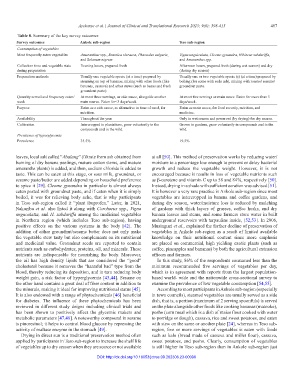
        Table 8. Summary of the key survey outcomes
        Survey outcomes           Ankole sub‑region                         Teso sub‑region
        Consumption of vegetables
        Most frequently eaten vegetables  Amaranthus spp., Brassica oleracea, Phaseolus vulgaris,   Vigna unguiculata, Cleome gynandra, Hibiscus sabdariffa,
                                   and Solanum nigrum                       and Amaranthus spp.
        Collection time and vegetable state   Evening hours, prepared fresh  Afternoon hours, prepared fresh (during wet season) and dry
        during preparation                                                  (during dry season)
        Preparation methods        Usually one vegetable specie (at a time) prepared by   Usually one or two vegetable specie (s) (at a time) prepared by
                                   steaming on top of bananas, mixing with other foods (like   boiling (for some with soda ash), mixing with roasted sesame/
                                   bananas, cassava) and other stews (such as beans and fresh   groundnut paste.
                                   groundnut paste).
        Quantity served and frequency eaten/  At most three servings, as side sauce, alongside another   At most five servings as main sauce. Eaten for more than 5
        week                       main source. Eaten for<3 days/week.      days/week.
        Purpose                    Eaten as a side sauce, as alternative in time of need, for   Eaten as main sauce, for food security, nutrition, and
                                   nutrition.                               medicine.
        Availability               Throughout the year                      Only in wet season and preserved (by drying) for dry season.
        Cultivation                Intercropped in plantations, grow voluntarily in the   Grown in gardens, grow voluntarily in compounds and in the
                                   compounds and in the wild.               wild.
        Prevalence of hyperglycemia
        Prevalence                 35.5%                                    19.5%


        leaves, local salt called “Abalang” (filtrate from ash obtained from   at all [50]. This method of preservation works by reducing water/
        burning of dry banana peelings, mature cotton stems, and mature   moisture to a percentage low enough to prevent or delay bacterial
        amaranths plants) is added, and then, sodium chloride is added to   growth and reduce the  vegetable  weight. However, it  is not
        taste. This can be eaten at this stage, or sour milk, groundnut, or   encouraged because it results in loss of vegetable nutrients such
        sesame paste/butter are added depending on household preference   as β-carotene and vitamin C up to 58 and 84%, respectively [50].
        to spice it [29]. Cleome gynandra in particular is almost always   Instead, drying in a shade with sufficient aeration was advised [51].
        eaten pasted with groundnut paste, and if eaten when it is simply   It is however a very rare practice in Ankole sub-region since most
        boiled, it was for relieving body ache, that is why participants   vegetables  are  intercropped  in  banana  and  coffee  gardens,  and
        in  Teso  sub-region  called  it  “plant  ibuprofen.”  Later,  in  2021,   during dry season, water/moisture loss is reduced by mulching
        Nakaziba et al. also listed it along with Corchorus spp., Vigna   of  gardens  with  thick  layers  of  grasses,  coffee  husks,  and  dry
        unguculatta, and H. sabdariffa among the medicinal vegetables   banana leaves and stems, and some farmers store water in built
        in Northern region (which includes  Teso sub-region), having   underground reservoirs with tarpaulins inside, [52,53]. In 2006,
        positive  effects  on  the  various  systems  in  the  body  [42].  The   Musinguzi et al., explained the further decline of preservation of
        addition of either groundnut/sesame butter does not only make   vegetables in Ankole sub-region as a result of limited available
        the vegetable stew tasty but also complements on its nutritional   knowledge on their nutritional  content  since more emphasis
        and medicinal  value. Groundnut seeds are reported to contain   are placed on commercial, high yielding exotic plants (such as
        nutrients such as carbohydrates, proteins, oil, and minerals. These   coffee, pineapples and bananas) by both the agricultural extension
        nutrients  are  indispensable  for  nourishing  the  body.  Moreover,   officers and farmers.
        the oil has high density lipids  that  are considered  the “good”   In this study, 86% of the respondents consumed less than the
        cholesterol because it removes the “harmful bad” type from the   minimum  recommended  five  servings  of  vegetables  per  day,
        blood, thereby reducing its deposition, and in turn reducing body   which is in agreement with reports from the largest population-
        weight gain, a risk factor of hyperglycemia [43,44]. Sesame on   based world- wide and the nationwide cross-sectional survey to
        the other hand contains a great deal of fiber content in addition to   examine the prevalence of low vegetable consumption [54,55].
        the minerals, making it ideal for improving nutritional status [45].   According to most participants in Ankole sub-region (especially
        It is also endowed with a range of phytochemicals [46] beneficial   in town councils), steamed vegetables are usually served as a side
        for  diabetes.  The  influence  of  these  phytochemicals  has  been   dish, that is, a portion (maximum of 2 serving spoonfuls) is served
        reviewed  in  different  study  deigns  including  clinical  trials  and   on the plate alongside other foods like cooking bananas (matooke),
        has  been  shown  to  positively  affect  the  glycemic  makers  and   posho (corn meal which is a dish of maize flour cooked with water
        metabolic parameters [47,48]. A noteworthy compound in sesame   to porridge or dough), cassava, rice and sweet potatoes, and eaten
        is pinoresinol; it helps to control blood glucose by repressing the   with stew on the same or another plate [24], whereas in Teso sub-
        activity of maltase enzyme in the stomach [49].         region, five or more servings of vegetables is eaten with foods
          Drying in direct sun is a traditional preservation method often   such as kalo (bread made of cassava and millet flour), cassava,
        applied by participants in Teso sub-region to increase the shelf life   sweet  potatoes,  and  posho.  Clearly,  consumption  of  vegetables
        of vegetables up to dry season when they are scarce or not available   is still higher in Teso sub-region than in Ankole sub-region just
                                          DOI: http://dx.doi.org/10.18053/jctres.09.202306.23-00096

