


Page 42 - JCTR-9-6
P. 42
406                       Asekenye et al. | Journal of Clinical and Translational Research 2023; 9(6): 398-413
        Table 6. (Continued)
        Characteristics                      FBG category                     CI (95%)          P‑value        OR
                                    Normal            Hyperglycemia
                                  N       %          N          %
        Frying
         No                      231      70.4       97        29.6          0.54 – 1.517        0.797         0.911
         Yes                      68      72.3       26        27.7
        Adding peanut/simsim butter
         No                      205      66.1      105        33.9          0.214 – 0.652       0.000         0.374
         Yes                      94      83.9       18        16.1
        Quantity eaten
         2 servings               76      62.8       45        37.2          0.144 – 0.685       0.004         0.314
         3 servings              109      66.1       56        33.9          0.185 – 0.825       0.014         0.391
         4 servings               52      83.9       10        16.1          0.300 – 2.096       0.640         0.793
         5 servings               62      83.8       12        16.2
        Days per week
         <3                       6       66.7       3         33.3          0.085 – 2.602       0.388         0.471
         3 – 5                   233      68.1      109        31.9          0.203 – 0.904       0.026         0.429
         >5                       60      84.5       11        15.5                                             1
        Notes: LI: Low intensity; MI: Moderate intensity; VI: Vigorous intensity; P-value, Statistically significant participants’ characteristic.

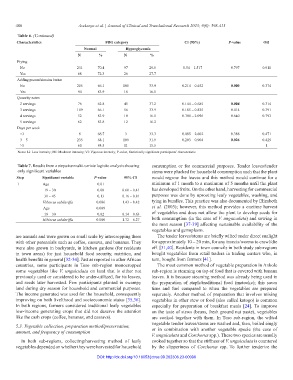
        Table 7. Results from a stepwise multi-variate logistic analysis showing   consumption  or  for  commercial  purposes. Tender  leaves/tender
        only significant variables                              stems were plucked for household consumption such that the plant
        Step       Significant variable  P‑value     95% CI     would regrow the leaves and this method would continue for a
        1          Age                    0.01                  minimum of 1 month to a maximum of 5 months until the plant
                   19 – 30                0.00      0.60 – 0.41  has developed fruits. On the other hand, harvesting for commercial
                   31 – 45                0.13      0.16 – 0.81  purposes was done by uprooting leafy vegetables, washing, and
                   Hibiscus sabdariffa   0.006      1.43 – 8.42  tying in bundles. This practice was also documented by Elizabeth
                   Age                   0.009                  et al. (2003); however, this method provides a onetime harvest
                   19 – 30                0.02      0.14 – 0.63  of vegetables and does not allow the plant to develop seeds for
                   Hibiscus sabdariffa   0.000      1.72 – 6.27  both consumption  (in the case of V. unguiculata) and sowing in
                                                                the next season [37-39] affecting sustainable availability of the
                                                                vegetables and germplasm.
        are annuals and were grown on small scale by intercropping them   The tender leaves/stems are briefly wilted under direct sunlight
        with other perennials such as coffee, cassava, and bananas. They   for approximately 10 – 20 min, for any insects/worms to crawl/die
        were also grown in backyards, in kitchen gardens (for residents   off. [31,40]. Residents in town councils in both study sub-regions
        in  town  areas)  for  just  household  food  security,  nutrition,  and   bought vegetables from retail traders in trading centers who, in
        health benefits in general [32-34]. Just as reported in other African   turn, bought from farmers [41].
        countries,  some participants  in  Teso  sub-region  monocropped   The most common method of vegetable preparation in Ankole
        some vegetables like  V. unguiculata on land  that  is either  not   sub-region is steaming on top of food that is covered with banana
        previously used or considered to be under-utilized, for its leaves,   leaves. It is because steaming method was already being used in
        and seeds later harvested. Few participants  planted in swampy   the  preparation  of  staple/traditional  food  (matooke);  this  saves
        land during dry season for household and commercial purposes.   time  and  fuel  compared  to  when  the  vegetables  are  prepared
        The income generated was used for the household, consequently   separately. Another method of preparation that involves mixing
        improving on both livelihood and socioeconomic status [35,36].   vegetables in other stew or food (also called katogo) is common
        In both regions, farmers considered traditional leafy vegetables   especially  for  preparation  of  breakfast  meals  [24]. To  improve
        low-income  generating  crops that  did not deserve the attention   on the taste of stews (beans, fresh ground nut paste), vegetables
        like the cash crops (coffee, bananas, and cassava).     are cooked together  with them.  In  Teso sub-region, the  wilted
                                                                vegetable tender leaves/stems are washed and, then, boiled singly
        5.3. Vegetable collection, preparation method/preservation,
        amount, and frequency of consumption                    or  in  combination  with  another  vegetable  specie  (the  case  of
                                                                V. unguiculata and Corchorus spp.). These two species are usually
          In  both  sub-regions,  collecting/harvesting  method  of  leafy   cooked together so that the stiffness of V. unguiculata is countered
        vegetables depended on whether they were harvested for household   by  the  slipperiness  of  Corchorus  spp.  To  further  tenderize  the
                                          DOI: http://dx.doi.org/10.18053/jctres.09.202306.23-00096

