


Page 39 - JCTR-9-6
P. 39
Asekenye et al. | Journal of Clinical and Translational Research 2023; 9(6): 398-413   403
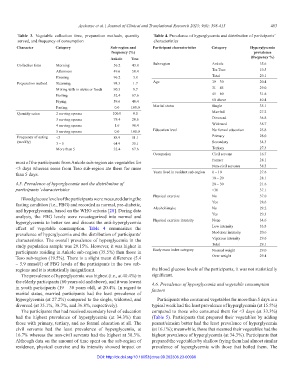
        Table  3.  Vegetable  collection  time,  preparation  methods,  quantity   Table 4. Prevalence of hyperglycemia and distribution of participants’
        served, and frequency of consumption                     characteristics
        Character       Category               Sub‑region and    Participant characteristics  Category   Hyperglycemia
                                                frequency (%)                                              prevalence
                                               Ankole   Teso                                              (frequency %)
        Collection time  Morning                56.2    43.8     Sub-region               Ankole             35.6
                        Afternoon               49.6    50.4                              Tes Teso           19.5
                        Evening                 96.2     3.8                              Total              29.1
        Preparation method  Steaming            98.3     1.7     Age                      19 – 30            20.4
                        Mixing with in stews or foods  90.3  9.7                          31 – 45            29.0
                        Boiling                 32.4    67.6                              45 – 60            31.6
                        Frying                  59.6    40.4                              60 above           40.4
                        Pasting                  0.0    100.0    Marital status           Single             35.1
        Quantity eaten  2 serving spoons        100.0    0.0                              Married            27.2
                        3 serving spoons        79.4    20.6                              Divorced           36.8
                        4 serving spoons         1.6    98.4                              Widowed            38.7
                        5 serving spoons         0.0    100.0    Education level          No formal education  25.8
        Frequency of eating   <3                88.9    11.1                              Primary            28.0
        (weekly)        3 – 5                   64.9    35.1                              Secondary          34.3
                        More than 5             32.4    67.6                              Tertiary           27.3
                                                                 Occupation               Civil servant      16.7

        most of the participants from Ankole sub-region ate vegetables for                Farmer             28.1
        <3 days whereas some from Teso sub-region ate them for more                       Non-civil servants  38.3
        than 5 days.                                             Years lived in resident sub-region  0 – 10  27.6
                                                                                          10 – 20            28.1
        4.5. Prevalence of hyperglycemia and the distribution of                          20 – 30            21.6
        participants’ characteristics                                                     ≥30                37.1

          Blood glucose levels of the participants were measured during the   Physical exercise  No          37.0
        fasting condition (i.e., FBG) and recorded as normal, pre-diabetic,               Yes                28.6
        and hyperglycemia, based on the WHO criteria [28]. During data   Alcohol intake   No                 29.2
        analysis, the FBG levels were re-categorized  into normal  and                    Yes                29.3
        hyperglycemia to better see and discuss the anti-hyperglycemia   Physical exercise intensity  None   34.6
        effect  of  vegetable  consumption.  Table  4 summarizes  the                     Low intensity      33.8
        prevalence of hyperglycemia and the distribution of participants’                 Moderate intensity  20.6
        characteristics. The  overall  prevalence  of  hyperglycemia  in  the             Vigorous intensity  29.6
        study population sample was 29.15%. However, it was higher in                     Total              29.1
        participants residing in Ankole sub-region (35.5%) than those in   Body mass index category  Normal weight  29.0
        Teso sub-region (19.5%). There is a slight mean difference (5.4                   Over weight        29.4
        – 5.9 mmol/l) of FBG levels of the participants in the two sub-
        regions and it is statistically insignificant.          the blood glucose levels of the participants, it was not statistically
          The prevalence of hyperglycemia was highest (i.e., at 40.4%) in   significant.
        the elderly participants (60 years old and above), and it was lowest   4.6. Prevalence of hyperglycemia and vegetable consumption
        in youth participants (19 – 30 years old), at 20.4%. In regard to   factors
        marital  status,  married  participants  had  the  least  prevalence  of
        hyperglycemia (at 27.2%) compared to the single, widowed, and   Participants who consumed vegetables for more than 5 days in a
        divorced (at 35.1%, 38.7%, and 36.8%, respectively).    typical week had the least prevalence of hyperglycemia (at 15.5%)
          The participants that had received secondary level of education   compared to those who consumed them for <3 days (at 33.3%)
        had  the  highest  prevalence  of  hyperglycemia  (at  34.3%)  than   (Table 5). Participants that prepared their vegetables by adding
        those with primary, tertiary, and no formal education at all. The   peanut/simsim butter had the least prevalence of hyperglycemia
        civil  servants  had  the  least  prevalence  of  hyperglycemia,  at   (at 16.1%); meanwhile, those that steamed their vegetables had the
        16.7% whereas the non-civil servants had the highest at 38.3%.   highest prevalence of hyperglycemia (at 34.3%). Participants that
        Although data on the amount of time spent on the sub-region of   prepared the vegetables by shallow frying them had almost similar
        residence, physical exercise and its intensity showed impact on   prevalence  of  hyperglycemia  with  those  that  boiled  them.  The
                                          DOI: http://dx.doi.org/10.18053/jctres.09.202306.23-00096

