


Page 40 - JCTR-9-6
P. 40
404                       Asekenye et al. | Journal of Clinical and Translational Research 2023; 9(6): 398-413
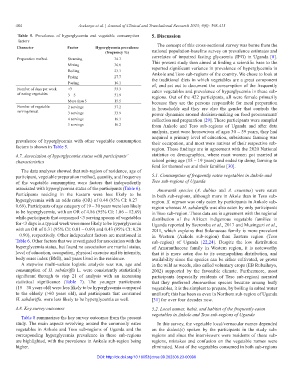
        Table  5.  Prevalence  of  hyperglycemia  and  vegetable  consumption   5. Discussion
        factors
        Character            Factor      Hyperglycemia prevalence   The concept of this cross-sectional survey was borne from the
                                             (frequency %)      national population-baseline survey on prevalence estimates and
        Preparation method   Steaming            34.3           correlates  of  impaired  fasting  glycaemia  (IFG)  in  Uganda  [8].
                             Mixing              36.6           This present study then aimed at finding a scientific base to the
                             Boiling             23.1           reported significant variance in prevalence of hyperglycemia in
                             Frying              27.7           Ankole and Teso sub-regions of the country. We chose to look at
                                                                the traditional diets in which vegetables are a great component
                             Pasting             16.1           of, and set out to document the consumption of the frequently
        Number of days per week   <3             33.3           eaten vegetables and prevalence of hyperglycemia in these sub-
        of eating vegetables  3 – 5              31.9           regions. Out of the 422 participants, all were female primarily
                             More than 5         15.5           because  they  are  the  persons  responsible  for  meal  preparation
        Number of vegetable   2 servings         37.2           in  households  and  they  are  also  the  gender  that  controls  the
        servings/meal        3 servings          33.9           power dynamics around decision-making on food procurement/
                             4 servings          16.1           collection and preparation [29]. These participants were sampled
                             5 servings          16.2           from  Ankole  and  Teso  sub-regions  of  Uganda  and  after  data
                                                                analysis, most were housewives of ages 30 – 59 years, they had
                                                                acquired a primary level of education, subsistence farming was
        prevalence of hyperglycemia with other vegetable consumption   their occupation, and most were natives of their respective sub-
        factors is shown in Table 5.                            region. These findings are in agreement with the 2020 National

        4.7. Association of hyperglycemia status with participants’   statistics on demographics, where most women got married at
        characteristics                                         school going age (15 – 19 years) and ended up doing farming to
                                                                fend for themselves and their families [30].
          The data analyses showed that sub-region of residence, age of
        participant, vegetable preparation method, quantity, and frequency   5.1. Consumption of frequently eaten vegetables in Ankole and
        of  the  vegetable  consumption  were  factors  that  independently   Teso sub-regions of Uganda
        associated with hyperglycemia status of the participants (Table 6).   Amaranth species (A. dubius and  A. cruentus) were eaten
        Participants  residing in the Eastern were less likely to be   in both sub-regions, although more in Akole than in Teso sub-
        hyperglycemia with an odds ratio (OR) of 0.44 (95% CI: 0.27 –   region. S. nigrum was only eaten by participants in Ankole sub-
        0.69). Participants of age category of 19 – 30 years were less likely   region whereas H. sabdariffa was also eaten by only participants
        to be hyperglycemia, with an OR of 4.86 (95% CI: 1.86 – 12.69)   in Teso sub-region. These data are in agreement with the regional
        while participants that consumed <3 serving spoons of vegetables   distribution  of  the  African  indigenous  vegetable  families  in
        for <3 days in a typical week were more likely to be hyperglycemia   Uganda reported by Sseremba et al., 2017 and Musinguzi et al.,
        with an OR of 0.31 (95% CI: 0.01 – 0.69) and 0.43 (95% CI: 0.20   2011, which explains that Solanaceae family is more prevalent
        – 0.90), respectively. Other independent factors are mentioned in   in  Western (Ankole sub-region) than Eastern region (Teso
        Table 6. Other factors that we investigated for association with the   sub-region)  of  Uganda  [22,24]. Despite the low distribution
        hyperglycemia status, but found no association are marital status,   of  Amaranthaceae  family  in  Western  region,  it  is  noteworthy
        level of education, occupation, physical exercise and its intensity,   that it is more eaten due to its cosmopolitan distribution, and
        body mass index (BMI), and years lived in the residence.  availability since the species can be either cultivated, or grows
          A stepwise multi-variate  logistic  analysis was run, age and   in the wild as weeds, also called voluntary crops (EB Rubaihayo,
        consumption  of  H.  sabdariffa  L.  were consistently  statistically   2002)  supported  by  the  favorable  climate.  Furthermore,  most
        significant  through  to  step  21  of  analysis  with  an  increasing   participants  (especially  residents  of  Teso  sub-region)  narrated
        statistical  significance  (Table  7).  The  younger  participants   that  they  preferred  Amaranthus  species  because  among  leafy
        (19 – 30 years old) were less likely to be hyperglycemia compared   vegetables, it is the simplest to prepare, by boiling in salted water
        to  the  elderly  (>60  years  old),  and  participants  that  consumed   until soft; this has been so even in Northern sub-region of Uganda
        H. sabdariffa. were less likely to be hyperglycemia as well.  [31] for over four decades now.

        4.8. Key survey outcomes                                5.2. Local names, habit, and habitat of the frequently eaten
                                                                vegetables in Ankole and Teso sub-regions of Uganda
          Table 8 summarizes the key survey outcomes from the present
        study. The  main  aspects  revolving  around the  commonly  eaten   In this survey, the vegetable local/vernacular names depended
        vegetables  in Ankole  and Teso  sub-regions  of  Uganda  and  the   on the dialect(s)  spoken by the participants  in the study sub-
        corresponding hyperglycemia  prevalence  in these sub-regions   regions and since the interviewers were residents of these sub-
        are highlighted, with the prevalence in Ankole sub-region being   regions,  mistakes  and  confusion  on  the  vegetable  names  were
        higher.                                                 eliminated. Most of the vegetables consumed in both sub-regions
                                          DOI: http://dx.doi.org/10.18053/jctres.09.202306.23-00096

