


Page 113 - MI-1-1
P. 113
Microbes & Immunity                                  Comprehensive genomic surveillance analysis of SARS-CoV-2


            public health.  Notably, as of January 17, 2023, the World   eight groups: VOC Alpha, VOC Beta, VOC Gamma, VOC
                       1
            Health Organization has reported a total of 662,445,150   Delta, VOC Omicron, variant of interest (VOI) Epsilon,
            confirmed cases of COVID-19 globally, including    VOI Iota, and Others, accounting for 924,692 genomes,
            6,704,827  deaths  (https://www.who.int/emergencies/  26,118 genomes, 92,904 genomes, 3,139,228 genomes,
            diseases/novel-coronavirus-2019),  as  well  as  the  462,017 genomes, 46,290 genomes, 24,238 genomes,
            administration of more than 13 billion doses of vaccine.   and 814,751 genomes, respectively. Notably, VOC Delta
            Now, more than 2 years since its emergence, the Omicron   constituted the majority, accounting for over half of the
            variant of concern (VOC) continues to define the current   total genomes deposited (3,139,228/5,530,238; 56.76%). In
            stage of the pandemic, representing a significant evolution   terms of geographical representation, 37,568 genomes were
            from previous COVID-19 variants. More than 3 years into   from Africa, 393,975 genomes were from Asia, 3,026,781
            the pandemic, the world is now facing the era of the VOC   genomes were from Europe, 1,888,466 genomes were from
            Omicron, distinctly different from earlier SARS-CoV-2   North America, 49,263 genomes were from Oceania, and
            strains. Enhancing global genomic sequencing capacities,   134,185 genomes were from South America. Notably,
            particularly  in  low-  and  middle-income  countries   Europe  accounted for  over  half  of  the  total  genomes
            (LMICs), is essential for improving public health responses   deposited (3,026,781/5,530,238; 54.73%). The number
                          2
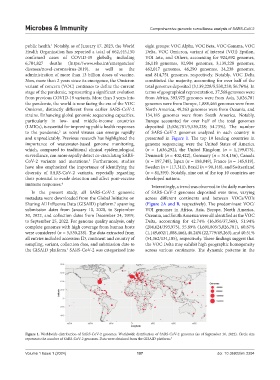
            to the pandemic,  as novel viruses can emerge rapidly   of  SARS-CoV-2  genomes  analyzed  in  each  country  is
            and unpredictably. Previous research has highlighted the   presented in  Figure  1. The top 10 leading countries in
            importance of wastewater-based genome monitoring,   genome sequencing were the United States of America
            which, compared to traditional clinical epidemiological   (n = 1,636,292), the United  Kingdom (n = 1,199,075),
            surveillance, can more rapidly detect co-circulating SARS-  Denmark (n = 402,422), Germany (n = 314,156), Canada
            CoV-2 variants and mutations.  Furthermore, studies   (n = 197,748), Japan (n = 188,849), France (n = 145,919),
                                       3
            have also emphasized the importance of identifying the   Sweden (n = 117,311), Brazil (n = 90,148), and Switzerland
            diversity of SARS-CoV-2 variants, especially regarding   (n = 81,393). Notably, nine out of the top 10 countries are
            their potential to evade detection and affect post-vaccine   developed nations.
            immune responses. 4                                  Interestingly, a trend was observed in the daily numbers
              In the present study, all SARS-CoV-2 genomic     of SARS-CoV-2 genomes deposited over time, varying
            metadata were downloaded from the Global Initiative on   across different continents and between VOCs/VOIs
            Sharing All Influenza Data (GISAID) platform,  spanning   (Figure 2A and B, respectively). The predominant VOC/
                                                  5
            submission dates from January 10, 2020, to September   VOI genomes in Africa, Asia, Europe, North America,
            30, 2022, and collection dates from December 24, 2019,   Oceania, and South America were all identified as the VOC
            to September 25, 2022. For genome quality analysis, only   Delta, accounting for 42.74% (16,056/37,568), 51.94%
            complete genomes with high coverage from human hosts   (204,624/393,975), 55.89% (1,691,805/3,026,781), 60.87%
            were considered (n = 5,530,238). The data extracted from   (1,149,602/1,888,466), 46.24% (22,779/49,263), and 40.51%
            all entries included accession ID, continent and country of   (54,362/134,185), respectively. These findings suggest that
            sampling, variant, collection date, and submission date to   the VOC Delta may exhibit high geographic homogeneity
                              5
            the GISAID platform.  SARS-CoV-2 was categorized into   across various continents. The dynamic patterns in the


            Figure 1. Worldwide distribution of SARS-CoV-2 genomes. Worldwide distribution of SARS-CoV-2 genomes (as of September 30, 2022). Circle size
            represents the number of SARS-CoV-2 genomes. Data were obtained from the GISAID platform. 5


            Volume 1 Issue 1 (2024)                        107                               doi: 10.36922/mi.2294

