


Page 115 - MI-1-1
P. 115
Microbes & Immunity                                  Comprehensive genomic surveillance analysis of SARS-CoV-2


            in submission lag times decreased over time for both   We further analyzed the fold increase in reproductive
            continents and VOCs/VOIs. The shortest submission lag   number against the date of lineage emergence over time
            times  for continents and VOCs/VOIs were Europe and   (as of August 15, 2022) based on publicly released data
            Omicron, respectively.                             provided by the Broad Institute of MIT and Harvard
                                                               (http://www.broadinstitute.org/) in the pyro-cov data
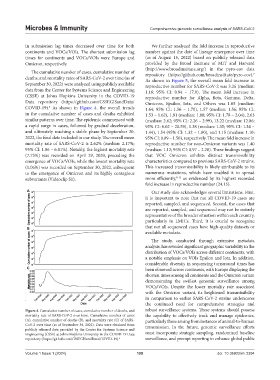
              The cumulative number of cases, cumulative number of   repository (https://github.com/broadinstitute/pyro-cov).
                                                                                                             7
            deaths, and mortality rates of SARS-CoV-2 over time (as of   As shown in Figure 5, the overall mean fold increase in
            September 30, 2022) were analyzed using publicly available   reproductive number for SARS-CoV-2 was 3.26 (median:
            data from the Center for Systems Science and Engineering   1.16; 95% CI: 0.84 – 17.0). The mean fold increase in
            (CSSE) at Johns Hopkins University in  the COVID-19   reproductive number for Alpha, Beta, Gamma, Delta,
            Data repository (https://github.com/CSSEGISandData/  Omicron, Epsilon, Iota, and Others was 1.65 (median:
            COVID-19).  As shown in  Figure  4, the overall trends   1.64;  95%  CI:  1.56  –  1.70), 1.57 (median:  1.56;  95%  CI:
                      6
            in the cumulative number of cases and deaths exhibited   1.53 – 1.62), 1.91 (median: 1.88; 95% CI: 1.78 – 2.04), 2.63
            similar patterns over time. The epidemic commenced with   (median: 2.62; 95% CI: 2.26 – 2.99), 13.22 (median: 12.06;
            a rapid surge in cases, followed by gradual deceleration,   95% CI: 6.02 – 20.59), 1.38 (median: 1.35; 95% CI: 1.34 –
            and ultimately reaching a stable phase by September 30,   1.44), 1.54 (95% CI: 1.32 – 1.80), and 1.15 (median: 1.10;
            2022, the final date included in our study. The overall mean   95% CI: 0.89 – 1.50), respectively. The mean fold increase in
            mortality rate of SARS-CoV-2 is 2.62% (median: 2.17%;   reproductive number for non-Omicron variants was 1.40
            95% CI: 1.06 – 6.81%). Notably, the highest mortality rate   (median: 1.12; 95% CI: 0.97 – 2.28). These findings suggest
            (7.73%) was recorded on April 29, 2020, preceding the   that VOC Omicron exhibits distinct transmissibility
            emergence of VOCs/VOIs, while the lowest mortality rate   characteristics compared to previous SARS-CoV-2 strains.
            (1.06%) was recorded on September 30, 2022, subsequent   This increased transmissibility is likely attributable to its
            to  the  emergence of  Omicron  and  its  highly  contagious   numerous mutations, which have enabled it to spread
            subvariants (Videoclip S1).                        more efficiently, 8-12  as evidenced by its highest recorded
                                                               fold increase in reproductive number (24.15).
             A                                                   Our study also acknowledges several limitations. First,
                                                               it is important to note that not all COVID-19  cases are
                                                               reported, sampled, and sequenced. Second, the cases that
                                                               are reported, sampled, and sequenced may not be entirely
                                                               representative of the broader situation within each country,
                                                               particularly  in LMICs. Third, it  is  crucial  to  recognize
            B                                                  that not all sequenced cases have high-quality datasets or
                                                               available metadata.
                                                                 The study, conducted through extensive metadata
                                                               analysis, has revealed significant geographic variability in the
                                                               distribution of VOCs/VOIs across different continents, with
                                                               a notable emphasis on VOIs Epsilon and Iota. In addition,
                                                               considerable diversity in sequencing turnaround times has
            C                                                  been observed across continents, with Europe displaying the
                                                               shortest times among all continents and the Omicron variant
                                                               demonstrating the swiftest genomic surveillance among
                                                               VOCs/VOIs. Despite the lower mortality rate associated
                                                               with the Omicron variant, its heightened transmissibility
                                                               in comparison to earlier SARS-CoV-2 strains underscores
                                                               the continued need for comprehensive strategies and
            Figure 4. Cumulative number of cases, cumulative number of deaths, and   robust surveillance systems. These systems should possess
            mortality rate of SARS-CoV-2 over time. Cumulative number of cases   the capability to effectively track and manage epidemics,
            (A), cumulative number of deaths (B), and mortality rate (C) of SARS-  particularly those arising from instances of animal-to-human
            CoV-2 over time (as of September 30, 2022). Data were obtained from   transmission. In the future, genomic surveillance efforts
            publicly released data provided by the Center for Systems Science and
            Engineering (CSSE) at Johns Hopkins University in the COVID-19 Data   must  incorporate  strategic  sampling,  randomized  baseline
            repository (https://github.com/CSSEGISandData/COVID-19). 6  surveillance, and prompt reporting to enhance global public


            Volume 1 Issue 1 (2024)                        109                               doi: 10.36922/mi.2294

