


Page 119 - MI-1-1
P. 119
Microbes & Immunity                                            Rare multi-site Klebsiella pneumoniae infections


            infections, endophthalmitis, meningitis/brain abscesses,   him unsuitable for more invasive operations, such as the
            necrotizing fasciitis, osteomyelitis, and infections at   removal of cerebral hematomas. Consequently, the patient
            surgical sites. 6                                  was treated in the intensive care unit (ICU).
              The prevalence of KP is particularly concerning in   During the 31-day hospitalization period, the patient
            areas with high population density and limited healthcare   experienced a fever of up to 40ve Subsequently, the patient
            resources, which exacerbate underlying conditions and   developed septic shock, necessitating the administration
            increase the incidence of infection. In nations like India,   of  vasopressors  to stabilize blood pressure. Blood
            the situation is critical due to the combination of dense   tests unveiled a marked increase in white blood cell
            health-care settings and suboptimal infection prevention   count (WBC) (33.8×10 /L), indicative of an infection,
                                                                                   9
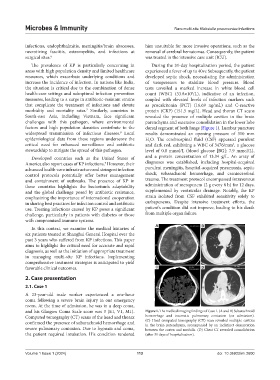
            measures, leading to a surge in antibiotic-resistant strains   coupled  with  elevated  levels  of  infection  markers  such
            that complicate the treatment of infections and elevate   as procalcitonin (PCT) (16.69  ng/mL) and C-reactive
            morbidity  and mortality rates.  Similarly, countries  in   protein (CRP) (151.5 mg/L). Head and thorax CT scans
                                      7
            South-east Asia, including Vietnam, face significant   revealed the presence of multiple cavities in the brain
            challenges with this pathogen, where environmental   parenchyma and extensive consolidation in the lower lobe
            factors and high population densities contribute to the   dorsal segment of both lungs (Figure 1). Lumbar puncture
            widespread transmission of infectious diseases.  Local   results demonstrated an opening pressure of 310  mm
                                                    8
            epidemiological data from these regions underscore the   H O. The cerebrospinal fluid (CSF) appeared purulent
                                                                2
            critical need for enhanced surveillance and antibiotic   and dark red, exhibiting a WBC of 3476/mm , a glucose
                                                                                                    3
            stewardship to mitigate the spread of this pathogen.  level of 0.8 mmol/L (blood glucose [BG]: 7.9 mmol/L),
              Developed countries such as the United States of   and a protein concentration of 13.34  g/L. An array of
                                              9
            America also report cases of KP infections.  However, their   diagnoses was established, including  hospital-acquired
            advanced health-care infrastructure and stringent infection   purulent meningitis, hospital-acquired pneumonia, septic
            control protocols potentially offer better management   shock,  subarachnoid  hemorrhage,  and  craniocerebral
            and containment of outbreaks. The presence of KP in   trauma. The treatment protocol encompassed intravenous
            these countries highlights the bacterium’s adaptability   administration of meropenem (2 g every 8 h) for 12 days,
            and the global challenge posed by antibiotic resistance,   supplemented by ventricular drainage. Notably, the KP
            emphasizing the importance of international cooperation   strain isolated from CSF exhibited sensitivity solely to
            in sharing best practices for infection control and antibiotic   carbapenems.  Despite  intensive  treatment  efforts,  the
            use. Treating infections caused by KP poses a significant   patient’s condition did not improve, leading to his death
            challenge, particularly in patients with diabetes or those   from multiple organ failure.
            with compromised immune systems.
                                                                   A                   B
              In this context, we examine the medical histories of
            six patients treated at Shanghai General Hospital over the
            past 3 years who suffered from KP infections. This paper
            aims to highlight the critical need for accurate and rapid
            diagnosis, as well as the initiation of appropriate treatment
            in managing multi-site KP infections. Implementing
            comprehensive treatment strategies is anticipated to yield
            favorable clinical outcomes.                           C                   D

            2. Case presentation
            2.1. Case 1
            A 23-year-old male worker experienced a one-hour
            coma following a severe brain injury in our emergency
            room. At the time of admission, he was in a deep coma,
            and his Glasgow Coma Scale score was 3 (E1, V1, M1).   Figure 1. The medical imaging findings of Case 1. (A and B) Subarachnoid
            Computed tomography (CT) scans of the head and thorax   hemorrhage  and  traumatic  pulmonary contusion  (on  admission).
            confirmed the presence of subarachnoid hemorrhage and   (C) Head computed tomography (CT) scan revealed multiple cavities
                                                               in the brain parenchyma, accompanied by an indistinct demarcation
            severe pulmonary contusion. Due to hypoxia and coma,   between the cortex and medulla. (D) Chest CT revealed consolidation
            the patient required intubation. His condition rendered   (after 31 days of hospitalization).


            Volume 1 Issue 1 (2024)                        113                               doi: 10.36922/mi.2600

