


Page 121 - MI-1-1
P. 121
Microbes & Immunity                                            Rare multi-site Klebsiella pneumoniae infections


            Laboratory testing revealed neutrophilic leukocytosis,   respiratory failure, and metabolic acidosis. Laboratory
            elevated levels of CRP (268  mg/L), PCT (15  ng/mL),   testing revealed a WBC of 13.1×10 /L, with neutrophils
                                                                                            9
            fasting BG (45 mmol/L), abnormal blood ketone bodies,   comprising 96% of the total count. BG level was 33 mmol/L
            and metabolic acidosis. ABG analysis while on 6  L/min   and blood ketones tested positive. PCT was >10 ng/mL,
            oxygen through nasal cannula demonstrated a pH of 7.0,   while CRP was 389 mg/L. Imaging examinations, including
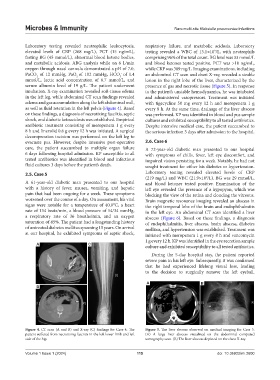
            PaCO  of 12  mmHg, PaO of 102  mmHg, HCO of 1.4    an abdominal CT scan and chest X-ray, revealed a sizable
                                                     -
                                                    3
                 2
                                  2
            mmol/L, lactic acid concentration of 8.7 mmol/L, and   lesion in the right lobe of the liver, characterized by the
            serum albumin level of 19  g/L. The patient underwent   presence of gas and necrotic tissue (Figure 5). In response
            intubation. X-ray examination revealed soft-tissue edema   to the patient’s unstable hemodynamics, he was intubated
            in the left leg, while abdominal CT scan findings revealed   and administered vasopressors. Treatment was initiated
            edema and gas accumulation along the left abdominal wall,   with tigecycline 50  mg every 12  h and meropenem 1  g
            as well as fluid retention in the left pelvis (Figure 4). Based   every 8 h. At the same time, drainage of the liver abscess
            on these findings, a diagnosis of necrotizing fasciitis, septic   was performed. KP was identified in blood and pus sample
            shock, and diabetic ketoacidosis was established. Empirical   cultures and exhibited susceptibility to all tested antibiotics.
            antibiotic treatment consisting of meropenem 1  g every   Despite intensive medical care, the patient succumbed to
            8 h and linezolid 0.6 g every 12 h was initiated. A surgical   the serious infection 3 days after admission to the hospital.
            decompression incision was performed on the left leg to
            evacuate pus. However, despite intensive post-operative   2.6. Case 6
            care, the patient succumbed to multiple organ failure   A 72-year-old diabetic man presented to our hospital
            6 days following hospital admission. KP susceptible to all   with  symptoms  of  chills,  fever,  left  eye  discomfort,  and
            tested antibiotics was identified in blood and infectious   impaired vision persisting for a week. Notably, he had not
            fluid cultures 3 days before the patient’s death.  sought treatment for either his diabetes or hypertension.

            2.5. Case 5                                        Laboratory testing revealed elevated levels of CRP
                                                                                         9
                                                               (219 mg/L) and WBC (21.9×10 /L). BG was 29 mmol/L,
            A 61-year-old diabetic man presented to our hospital   and blood ketones tested positive. Examination of the
            with a history of fever, nausea, vomiting, and hepatic   left eye revealed the presence of a hypopyon, which was
            pain that had been ongoing for a week. These symptoms   blocking the view of the retina and clouding the vitreous.
            worsened over the course of a day. On assessment, his vital   Brain magnetic resonance imaging revealed an abscess in
            signs  were  notable  for  a  temperature  of  40.0°C,  a  heart   the right temporal lobe of the brain and endophthalmitis
            rate of 134 beats/min, a blood pressure of 54/34 mmHg,   in the left eye. An abdominal CT scan identified a liver
            a respiratory rate of 36 breaths/min, and an oxygen   abscess (Figure  6). Based on these findings, a diagnosis
            saturation of 85%. The patient had a longstanding history   of endophthalmitis, liver abscess, brain abscess, diabetes
            of untreated diabetes mellitus spanning 15 years. On arrival   mellitus, and hypertension was established. Treatment was
            at our hospital, he exhibited symptoms of septic shock,   initiated with meropenem 1 g every 8 h and vancomycin
                                                               1 g every 12 h. KP was identified in the eye secretion sample
                 A                     C
                                                               culture and exhibited susceptibility to all tested antibiotics.
                                                                 During the 5-day hospital stay, the patient reported
                                                               severe pain in his left eye. Subsequently, it was confirmed
                                                               that he had experienced lifelong visual loss, leading
                                                               to the decision to surgically remove the left eyeball.

                                                               A                      B
                 B


            Figure  4. CT scan (A and B) and X-ray (C) findings for Case 4. The   Figure  5. The liver abscess observed on medical imaging for Case 5.
            patient suffered from necrotizing fasciitis in the left lower limb and left   (A) A large liver abscess visualized on the abdominal computed
            side of the hip.                                   tomography scan. (B) The liver abscess depicted on the chest X-ray.


            Volume 1 Issue 1 (2024)                        115                               doi: 10.36922/mi.2600

