


Page 120 - MI-1-1
P. 120
Microbes & Immunity                                            Rare multi-site Klebsiella pneumoniae infections


            2.2. Case 2                                        12.1 mmol/L, base excess of −23.5 mmol/L, and lactic

            A 72-year-old woman presented with a history of decreased   acid concentration of 10.1 mmol/L. Abdominal CT scan
            appetite, lumbago, and persistent high temperature for   findings revealed an indistinct outer section of the spleen,
            15  days, followed by the onset of disorientation and   indicative of  abscess  formation  (Figure  3).  Intravenous
                                                               administration of meropenem 1 g every 8 h was initiated,
            nonsensical speech. Notably, she had left her diabetes   along  with abscess drainage. Bacterial cultures  from
            mellitus untreated for 20  years. On admission, the   blood and pus samples revealed the presence of KP, which
            patient exhibited resistance to physical examination.   exhibited susceptibility to all tested antibiotics. Following
            Clinical evaluation revealed symptoms of high fever,   surgery and antibiotic therapy, the patient demonstrated
            rapid breathing, and tachycardia. Her oxygen saturation   significant improvement in health status. Subsequent
            level was 91% despite receiving 6 L of oxygen per minute   telephone  follow-up  confirmed  the  patient’s  good
            through a nasal cannula. Laboratory testing revealed   condition.
                                                       9
            neutrophilic leukocytosis, elevated WBC (17.09×10 /L),
            CRP (255 mg/L), PCT (4.31 ng/mL), and fasting BG (33.1   2.4. Case 4
            mmol/L), with other blood parameters within normal   A 45-year-old woman presented to our hospital with
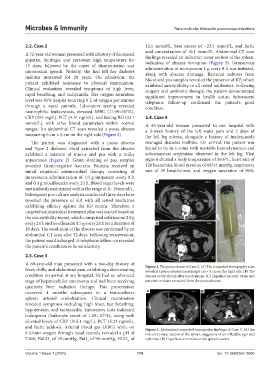
            ranges. An abdominal CT scan revealed a psoas abscess   a 3-week history of the left waist pain and 2  days of
            measuring 6 cm × 8 cm on the right side (Figure 2).  the left leg edema, alongside a history of inadequately
              The patient was diagnosed with a psoas abscess   managed diabetes mellitus. On arrival, the patient was
            and Type  2 diabetes. Fluid extracted from the abscess   found to be in a coma with unstable hemodynamics and
            exhibited a mixture of mucus and pus with a milky   subcutaneous crepitation observed in the left leg. Vital
            appearance (Figure  2). Gram staining of pus samples   signs indicated a body temperature of 39.6°C, heart rate of
            revealed Gram-negative bacteria. Patients received an   126 beats/min, blood pressure of 68/44 mmHg, respiratory
            initial empirical antimicrobial therapy consisting of   rate of 29 breaths/min, and oxygen saturation of 90%.
            intravenous administration of 1.0 g imipenem every 8 h
            and 0.4 g moxifloxacin every 24 h. Blood sugar levels were   A                   C
            meticulously maintained within the range of  8– 10 mmol/L.
            Subsequent pus culture analysis conducted three days later
            revealed the presence of KP, with all tested medicines
            exhibiting efficacy against the KP strains. Therefore, a
            targeted antimicrobial treatment plan was started based on
            the susceptibility report, which comprised ceftriaxone 2.0 g
            every 24 h and levofloxacin 0.5 g every 24 h for a duration of   B
            10 days. The resolution of the abscess was confirmed by an
            abdominal CT scan after 32 days. Following recuperation,
            the patient was discharged. A telephone follow-up revealed
            the patient’s condition to be satisfactory.
            2.3. Case 3
            A  69-year-old  man  presented  with  a  two-day  history  of   Figure 2. The psoas abcess in Case 2. (A) The computed tomography scan
            fever, chills, and abdominal pain, exhibiting a deteriorating   revealed a psoas abscess measuring 6 cm × 8 cm on the right side. (B) The
            condition on arrival at our hospital. He had an advanced   abscess cavity shrank after pus drainage. (C) Liquefied necrotic tissue and
            stage of hepatocellular carcinoma and had been receiving   purulent exudate extracted from the psoas abscess.
            quarterly  liver  radiation  therapy.  This  presentation
            occurred  4  months  subsequent to  a transcatheter   A                    B
            splenic arterial embolization. Clinical examination
            revealed symptoms including high fever, fast breathing,
            hypotension, and tachycardia. Laboratory tests indicated
            leukopenia (leukocyte count of 1.09×10 /L), along with
                                             9
            elevated levels of CRP (315.1 mg/L), PCT (5.23 ng/mL),
            and lactic acidosis. Arterial blood gas (ABG) while on   Figure 3. Abdominal computed tomography findings of Case 3. (A) An
            6 L/min oxygen through nasal cannula revealed a pH of   indistinct outer section of the spleen, suggestive of an inflatable sign and
            7.010, PaCO  of 18 mmHg, PaO  of 96 mmHg, HCO of   ischemia. (B) Liquefactive necrosis in the spleen’s cortex.
                                                        -
                                                       3
                      2
                                      2
            Volume 1 Issue 1 (2024)                        114                               doi: 10.36922/mi.2600

