


Page 21 - MI-1-1
P. 21
Microbes & Immunity                                      RANTES/CCL5 and ezrin peptide RepG3 for long COVID


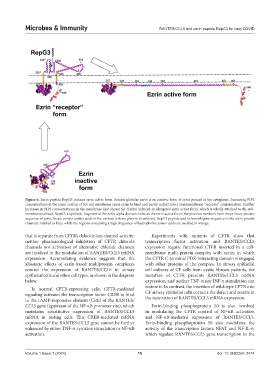
            Figure 6. Ezrin peptide RepG3 induces ezrin active form. Soluble globular ezrin is an inactive form of ezrin present in the cytoplasm. Increasing PIP2
            concentrations at the inner surface of the cell membrane cause ezrin to bind and partly unfold into a transmembrane “receptor” conformation. Further
            increases in PIP2 concentrations in the membrane (not shown for clarity) induced an elongated ezrin active form, which is wholly attached to the sub-
            membrane surface. RepG3, a synthetic fragment of the ezrin alpha domain, induces the ezrin active form (the position numbers from the primary protein
            sequence of ezrin, locate certain amino acids in the various tertiary protein structures). RepG3 peptide and its homologous sequence in the ezrin protein
            chain are marked in blue, while the regions containing a high frequency of hydrophobic amino acids are marked in orange.

            that is separate from CFTR’s chloride-ion channel activity:   Experiments with mutants of CFTR show that
            neither  pharmacological  inhibition  of  CFTR  chloride   transcription factor activation and RANTES/CCL5
            channels nor activation of alternative chloride channels   expression require functional CTFR inserted in a cell-
            are involved in the modulation of RANTES/CCL5 mRNA   membrane multi-protein-complex with ezrin, in which
            expression.  Accumulating  evidence  suggests  that  the   the CFTR C-terminal PDZ-interacting domain is engaged
            allosteric effects of ezrin-based multiprotein complexes   with other proteins of the complex. In airway epithelial
            control the expression of RANTES/CCL5 in airway    cell cultures of CF cells from cystic fibrosis patients, the
            epithelial cells and other cell types, as shown in the diagram   mutation of CTFR prevents RANTES/CCL5 mRNA
            below.                                             expression, and neither TNF-α nor INF-γ stimulation can
              In normal CFTR-expressing cells, CFTR-mediated   restore it. In contrast, the insertion of wild-type CFTR into
            signaling activates the transcription factor CREB to bind   CF airway epithelial cells corrects the defect and results in
            to the cAMP-responsive element (CRE) of the RANTES/  the restoration of RANTES/CCL5 mRNA expression.
            CCL5 gene (upstream of the NF-κB promoter site), which   Ezrin-binding phosphoprotein 50 is also involved
            maintains  constitutive  expression  of RANTES/CCL5   in modulating the CFTR control of NF-κB activation
            mRNA in resting cells. This CREB-mediated mRNA     and NF-κB-mediated expression of RANTES/CCL5.
            expression of the RANTES/CCL5 gene cannot be further   Ezrin-binding phosphoprotein 50 also modulates the
            enhanced by either TNF-α cytokine stimulation or NF-κB   activity of the transcription factors NFAT and NF-IL-6,
            activation.                                        which regulate RANTES/CCL5 gene transcription in the


            Volume 1 Issue 1 (2024)                         15                               doi: 10.36922/mi.2474

