


Page 25 - MI-1-1
P. 25
Microbes & Immunity                                      RANTES/CCL5 and ezrin peptide RepG3 for long COVID


            ezrin peptides both increase HLA-DR expression in   life in the lyophilized form. Not only do ezrin peptides
            monocytes and macrophages.                         have an exceptional safety record, but they also have
              The wide spectrum of biological effects of RANTES/  efficacy against all bacterial, viral, fungal, and protozoan
            CCL5 that are common with ezrin peptides, and the   infections.
            observed elevation of RANTES/CCL5 serum levels in    Ezrin peptide RepG3 is unique in that it increases
            response to ezrin peptide RepG3, suggests that ezrin   the  expression  of  adaptive  immune-amplifier  RANTES/
            peptides act to increase the expression of RANTES/CCL5,   CCL5 while inhibiting the expression of innate immunity
            the natural amplifier of adaptive immune responses.  In   proinflammatory cytokines. Ezrin peptide RepG3 is a
                                                       86
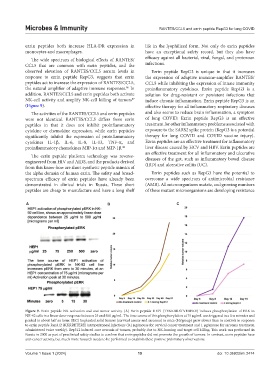
            addition, RANTES/CCL5 and ezrin peptides both activate   solution for drug-resistant or persistent infections that
            NK-cell activity  and amplify NK-cell  killing of  tumors    induce chronic inflammation. Ezrin peptide RepG3 is an
                                                         87
            (Figure 9).                                        effective therapy for all inflammatory respiratory diseases
              The activities of the RANTES/CCL5 and ezrin peptides   and also seems to reduce brain inflammation, a symptom
            were not identical. RANTES/CCL5 differs from ezrin   of  long COVID.  Ezrin  peptide  RepG3  is  an effective
            peptides in that it does not inhibit proinflammatory   treatment for other inflammatory problems associated with
            cytokine  or chemokine expression, while  ezrin  peptides   exposure to the SARS2 spike protein (RepG3 is a potential
            significantly inhibit the expression of proinflammatory   therapy for long COVID and COVID vaccine injury).
            cytokines IL-1β, IL-6, IL-8, IL-13, TNF-α, and     Ezrin peptides are an effective treatment for inflammatory
            proinflammatory chemokines MIP-1α and MIP-1β. 88   liver disease caused by HCV and HBV. Ezrin peptides are
                                                               an effective treatment for all inflammatory and ulcerative
              The ezrin peptide platform technology was reverse-
            engineered from HIV and AIDS, and the products derived   diseases of the gut, such as inflammatory bowel disease
                                                               (IBD) and ulcerative colitis (UC).
            from this know-how are short synthetic peptide mimics of
            the alpha domain of human ezrin. The safety and broad-  Ezrin peptides such as RepG3 have the potential to
            spectrum efficacy of ezrin peptides have already been   overcome a wide spectrum of antimicrobial resistance
            demonstrated in clinical trials in Russia. These short   (AMR). All microorganisms mutate, and growing numbers
            peptides are cheap to manufacture and have a long shelf   of these mutant microorganisms are developing resistance

            A                                  B                            C


            Figure 9. Ezrin peptide NK activation and anti-tumor activity. (A) Ezrin peptide HEP1 (TEKKRRETVEREKE) induces phosphorylation of ERK in
            NK-92 cells in a linear dose-response between 25 and 500 µg/mL. The time course of this phosphorylation at 75 µg/mL was triggered in a few minutes and
            peaked in about half an hour. (B,C) Implanted solid tumors (cervical cancer and sarcoma) in mice (10/group) grew slower than in controls in response
            to ezrin peptide Rep312 (KKRRETERE) intraperitoneal injections (0.1 µg/mouse for cervical cancer treatment and 1 µg/mouse for sarcoma treatment,
            administered twice weekly). Rep312 induced core necrosis of tumors, probably due to NK-homing and target cell killing. This work was performed in
            Russia in 2000 as part of preclinical safety studies to confirm that ezrin peptides did not promote the growth of tumors. In contrast, ezrin peptides have
            anti-cancer activity, but much more research needs to be performed to establish these positive preliminary observations.


            Volume 1 Issue 1 (2024)                         19                               doi: 10.36922/mi.2474

