


Page 78 - MI-1-1
P. 78
Microbes & Immunity                                                      An ATP-free packaging of T4 DNA


            A                      C                           Pi and Ca  could determine the conformation of DNA,
                                                                       2+
                                                               which triggers either the packaging or the ejection of
                                                               DNA. Specifically, increasing the concentration of Ca
                                                                                                            2+
                                                               or decreasing the Pi concentration could induce the
                                                               packaging of DNA (Table 1).
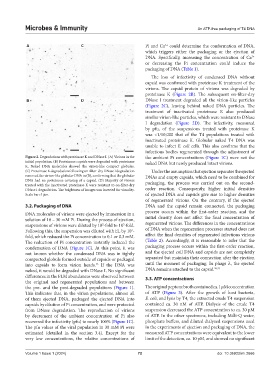
                                                                 The loss of infectivity of condensed DNA without
                                                               capsid was confirmed with proteinase K treatment of the
                                                               virions. The capsid protein of virions was degraded by
                                                               proteinase  K (Figure  2B).  The subsequent  on-filter-dry
            B                       D                          DNase I treatment degraded all the virion-like particles
                                                               (Figure  2C), leaving behind naked DNA particles. The
                                                               treatment of inactivated proteinase K also produced
                                                               similar virion-like particles, which were resistant to DNase
                                                               I  degradation  (Figure  2D).  The infectivity,  measured
                                                               by pfu, of the suspensions treated with proteinase K
                                                               was <1/10,000 that of the T4 populations treated with
                                                               inactivated proteinase K.  Globular naked T4 DNA was
                                                               unable to infect E. coli cells. This also confirms that the
                                                               infectious bodies regenerated through the adjustment of
            Figure 2. Degradations with proteinase K and DNase I. (A) Virions in the   the ambient Pi concentrations (Figure  1C) were not the
            initial population. (B) Proteinous capsids were degraded with proteinase   naked DNA but newly produced intact virions.
            K. Naked DNA molecules showed the virion-like compact globules.
            (C) Proteinase K degradation following on-filter-dry DNase I degradation   Under the assumption that ejection separates the ejected
            removed the virion-like globular DNA in (B), confirming that the globular   DNAs and empty capsids, which need to be combined for
            DNA had no proteinous covering of a capsid. (D) Majority of virions   packaging, the process was carried out on the second-
            treated with the inactivated proteinase K were resistant to on-filter-dry
            DNase I degradation. The brightness of images was inverted for visuality.   order reaction. Consequently, higher initial densities
            Scale bar: 5 μm.                                   of ejected DNA and capsids give rise to higher densities
                                                               of  regenerated  virions.  On  the contrary, if  the  ejected
            3.2. Packaging of DNA                              DNA and the capsid remain connected, the packaging
            DNA molecules of virions were ejected by immersion in a   process  occurs  within  the  first-order  reaction,  and  the
            solution of 10 – 30 mM Pi. During the process of ejection,   initial density does not affect the final concentration of
            suspensions of virions were diluted by 10 -fold to 10 -fold.   regenerated virions. The differences in the concentrations
                                             2
                                                     5
            Following this, the suspension was diluted with EL by 10 -  of DNA when the regeneration processes started does not
                                                         2
            fold, which reduced the Pi concentration to 0.1 or 0.3 mM.   affect the final densities of regenerated infectious virions
            The reduction of Pi concentration instantly induced the   (Table  2). Accordingly, it is reasonable to infer that the
            condensation of DNA (Figure  1C). At this point, it was   packaging process occurs within the first-order reaction,
            not known whether the condensed DNA was in tightly   and the ejected coil DNA and capsids are not completely
            compacted globule formed outside of capsids or packaged   separated but maintain their connection after the ejection
            into  capsids  to  form  virion  heads.   If  the  DNA  was   until the moment of packaging. In phage  λ, the ejected
                                          25
            naked, it would be degraded with DNase I. No significant   DNA remains attached to the capsid. 26,27
            differences in the FLM abundances were observed between   3.3. ATP concentrations
            the  original  and regenerated populations  and between
            the pre-  and the post-degraded populations (Figure  1).   The original peptone broth contained ca. 1 μM concentration
            This indicates that, in the virion populations, almost all   of ATP (Figure  3). After the growth of host bacteria,
            of them ejected DNA, packaged the ejected DNA into   E. coli, and lysis by T4, the extracted crude T4 suspension
            capsids by dilution of Pi concentration, and were protected   contained ca. 30 nM of ATP. Dialysis of the crude T4
            from DNase degradation. The reproduction of virions   suspension decreased the ATP concentration to ca. 30 pM
            by decrement of the ambient concentration of Pi also   of ATP. In the other specimens, including Milli-Q water,
            recovered the infectivity (pfu) to nearly 100% (Figure 1C).   phosphate buffers, and diluted dialyzed suspensions used
            The pfu values of the viral population in 30 mM Pi were   in the experiments of ejection and packaging of DNA, the
            estimated (detailed in  the  section 3.4).  Except  for the   measured ATP concentrations were equivalent to the lower
            very  low concentrations,  the relative concentrations of   limit of the detection, ca. 10 pM, and showed no significant


            Volume 1 Issue 1 (2024)                         72                               doi: 10.36922/mi.2666

