


Page 81 - MI-1-1
P. 81
Microbes & Immunity                                                      An ATP-free packaging of T4 DNA


                                                                 The step-by-step mechanism of the ejection of DNA
                                                               was not investigated in this study. However, the completed
                                                               head and tail have been shown to join spontaneously
                                                               after  DNA  packaging is  completed  in the  assembly of
                                                               bacteriophage. 32,33  Therefore, it is presumed that, in the
                                                               ejection of DNA from a capsid, the tail may detach from
                                                               the connector first and the ejection of DNA from the
                                                               connector  follows,  according  to  the  increment  of  the
                                                               ambient phosphate concentration.
                                                               4.2. Packaging of DNA
                                                               Before packaging, it would be appropriate to examine again
                                                               if there were any intact virions in the 30 mM Pi suspension.
                                                               The FLM observations clearly indicated ejection of the
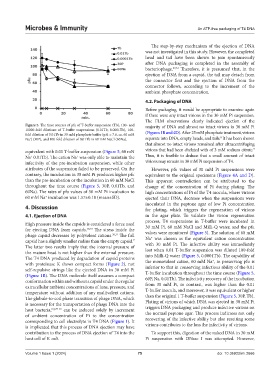
            Figure 5. The time courses of pfu of T-buffer suspension (Tb), 100- and   majority of DNA and almost no intact virions in 30 mM Pi
            10000-fold dilutions of T-buffer suspensions (0.01Tb, 0.0001Tb), 100-
            fold dilution of 0.01Tb in 30 mM phosphate buffer (pH = 7.6, ca. 60 mM   (Figures 1B and 4D). After 25 mM phosphate treatment, virions
                                                                                               8
            Na ) (30P), and 100-fold dilution of 0.01Tb in 60 mM NaCl (60Na).  separate into DNA, empty heads, and tails.  It has been shown
              +
                                                               that almost no intact virions remained after ultracentrifuging
                                                                                                             9
            equivalent with 0.01 T-buffer suspension (Figure 5, 60 mN   virions that had been chelated with of 3 mM sodium citrate.
                                  +
            Na  0.01Tb). The cation Na  was only able to maintain the   Thus, it is feasible to deduce that a small amount of intact
              +
            infectivity of the pre-incubation suspension, while other   virions may remain in 30 mM Pi suspension of T4.
            attributes of the suspension failed to be preserved. On the   However, pfu values of 30 mM Pi suspensions were
            contrary, the incubation in 30 mM Pi produces higher pfu   equivalent to the original specimens (Figure 4A and D).
            than the pre-incubation or the incubation in 60 mM NaCl   This apparent contradiction can be attributed to the
            throughout the time course (Figure  5, 30P, 0.01Tb, and   change of the concentration of Pi during plating. The
            60Na). The rates of pfu values of 30 mM Pi incubation to   high concentrations of Pi of the T4 inocula, where virions
            60 mM Na  incubation was 1.57±0.18 (mean±SD).      ejected their DNA, decrease when the suspensions were
                    +
                                                               inoculated in the peptone agar of low Pi concentration
            4. Discussion                                      for  plating,  which  triggers  the  regeneration  of  virions
            4.1. Ejection of DNA                               in the agar plate. To validate the virion regeneration
                                                               process, T4 suspensions in T-buffer were incubated in
            High pressure inside the capsids is considered a force used
            for  ejecting  DNA  from  capsids. 28,29   The  stress  inside  the   30 mM Pi, 60 mM NaCl and Milli-Q water, and the pfu
            phage capsid decreases by polyvalent cations. 30,31  The full   values were monitored (Figure 5). The solution of 60 mM
                                                               Na  was chosen as the equivalent cation concentration
                                                                 +
            capsid has a slightly smaller radius than the empty capsid.    with 30 mM Pi. The infective ability was immediately
                                                          7
            The latter two results imply that the internal pressure of   lost when 0.01 T-buffer suspension was diluted 100-fold
            the mature head is not higher than the external pressure.
            The T4 DNA produced by degradation of capsid proteins   into Milli-Q water (Figure 5, 0.0001Tb). The capability of
                                                                                           +
            with proteinase K shows compact forms (Figure  2), not   the monovalent cation, 60 mM Na , in preserving pfu is
            self-repulsive strings like the ejected DNA in 30 mM Pi   inferior to that in conserving infectious ability of the 0.01
                                                               T-buffer incubation throughout the time course (Figure 5,
            (Figure 1B). The DNA molecule itself assumes a compact
            conformation within and without a capsid under the regular   60P, Na, 0.01Tb). The infectivity recovery of the incubation
            extracellular ambient concentrations of ions, pressure, and   from  30  mM  Pi,  in  contrast,  was  higher  than  the  0.01
            temperature without addition of any multivalent cations.   T-buffer inocula, and moreover, it was equivalent or higher
            The globule-to-coil phase transition of phage DNA, which   than the original 1 T-buffer suspension (Figure 5, 30P, Tb).
                                                               Plating of virions of which DNA was ejected in 30 mM Pi
            is necessary for the transportation of phage DNA into the
            host bacteria, 8,9,27-29  can be induced solely by increment   triggers DNA packaging and produce infective virions on
            of ambient concentration of Pi to the concentration   the normal peptone agar. This process indicates not only
            corresponding to cell electrolyte in T4 DNA (Figure 1). It   recovering of the infective ability but also resetting some
            is implicated that this process of DNA ejection may have   virions contributes to the loss the infectivity of virions.
            contribution to the process of DNA ejection of T4 into the   To support this, digestion of the naked DNA in 30 mM
            host cell of E. coli.                              Pi suspension with DNase I was attempted. However,


            Volume 1 Issue 1 (2024)                         75                               doi: 10.36922/mi.2666

