


Page 66 - MI-1-2
P. 66
Microbes & Immunity                                                   Viral, bacterial, and protozoal diseases


            qualitatively detects HBsAg in human blood. It is an in vitro   two organisms is not significant and indicates probable
            diagnostic technique with a sensitivity and specificity of   contamination.
            92.2% and 99.3%, respectively. The test was performed and
            interpreted according to the manufacturer’s specifications.   2.10. Statistical analysis
            Briefly, one drop (approximately 25 μL) of the whole blood   The data generated in this study was analyzed using
            aliquot sample was drawn into the specimen pad of the   the Statistical Package for the Social Sciences software
            test strip, and one drop of buffer (approximately 40 μL)   version 17.0 for Windows. In addition, one-way analysis of
            was added. A positive result was indicated by two visible   variance was employed where appropriate to determine the
            lines on both the test and control regions between 10 and   level of statistical significance. A P < 0.05 was considered
            15 min.                                            significant.

            2.7. Assay for typhoid                             3. Results
            The study employed the Widal Kit (Rapid Labs Diagnostic,   3.1. Distribution of infectious diseases among
            United Kingdom) for the Widal agglutination test. Briefly,   patients attending the Ore General Hospital
            eight drops of each serum prepared above were dispensed   HIV accounted for a prevalence of 40% (400/1,000),
            in each of the eight circles on the test card. To each circle,   malaria was 35% (700/2,000), HBsAg was 20% (80/400),
            a drop of polyvalent  Salmonella O  (somatic antigen)   H. pylori was 6.3% (20/300), HVS was 45% (90/200), and
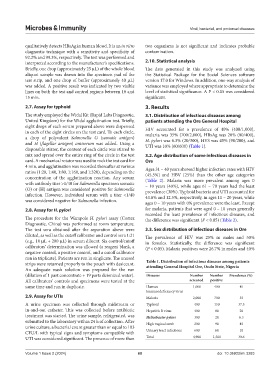
            and H  (flagellar antigen)  antiserum  was added. Using a   UTI was 10% (60/600) (Table 1).
            disposable stirrer, the content of each circle was stirred to
            mix and spread over the entire ring of the circle in the test   3.2. Age distribution of some infectious diseases in
            card. A mechanical rotator was used to rock the test card for   Ore
            4 min, and agglutination was recorded thereafter at various   Ages 31 – 40 years showed higher infection rates with HIV
            ratios (1:20, 1:40, 1:80, 1:160, and 1:320), depending on the   (45.5%) and HBV (25%) than the other age categories
            concentration of  the  agglutination reaction. Any  serum   (Table  2). Malaria was more prevalent among ages 0
            with antibody titer >1/40 for Salmonella specimen somatic   – 10 years (40%), while ages 61 – 70 years had the least
            (O) or (H) antigen was considered positive for Salmonella   prevalence (30%). Typhoid bacteria and UTI accounted for
            infection. However, individual serum with a titer <1/40   43.8% and 12.5%, respectively, in ages 11 – 20 years, while
            was considered negative for Salmonella infection.  ages 0 – 10 years with 0% prevalence were the least. Except

            2.8. Assay for H. pylori                           for malaria, patients that were aged 0 – 10 years generally
                                                               recorded the least prevalence of infectious diseases, and
            The  procedure  for  the  Wampole  H. pylori  assay  (Cortez   the difference was significant (P < 0.05) (Table 2).
            Diagnostic, China) was performed at room temperature.
            The test sera obtained after the separation above were   3.3. Sex distribution of infectious diseases in Ore
            diluted, as well as the cutoff calibrator and control sera 1:21   The prevalence of HIV was 25% in males and 50%
            (e.g., 10 μL + 200 μL) in serum diluent. Six control/cutoff   in females. Statistically, the difference was significant
            calibrators’ determination was allowed (a reagent blank, a   (P < 0.05). Malaria positives were 26.7% in males and 40%
            negative control, a positive control, and a cutoff calibrator
            run in triplicate). Patients are run in singlicate. The unused
            strips were returned properly to the pouch with desiccant.   Table 1. Distribution of infectious diseases among patients
                                                               attending General Hospital Ore, Ondo State, Nigeria
            An adequate wash solution was prepared for the run
            (dilution of 1 part concentrate + 19 parts deionized water).   Diseases  Number   Number   Prevalence (%)
            All calibrators’ controls and specimens were tested at the            screened  positive
            same time and run in duplicate.                    Human               1,000    400        40
                                                               immunodeficiency virus
            2.9. Assay for UTIs                                Malaria             2,000    700        35
            A urine specimen was collected through midstream or   Typhoid           400     150       37.5
            in-and-out catheter. This was collected before antibiotic   Hepatitis B virus  400  80     20
            treatment was started. The urine sample, refrigerated, was   Helicobacter pylori  300  20  6.3
            submitted to the laboratory within 24 h of collection. After   High vaginal swab  200  90  45
            urine culture, a bacterial count greater than or equal to 103
            CFU/L with typical signs and symptoms compatible with   Urinary tract infections  600  60  10
            UTI was considered significant. The presence of more than   Total      4,900    1,500     30.6


            Volume 1 Issue 2 (2024)                         60                               doi: 10.36922/mi.3283

