


Page 68 - MI-1-2
P. 68
Microbes & Immunity                                                   Viral, bacterial, and protozoal diseases


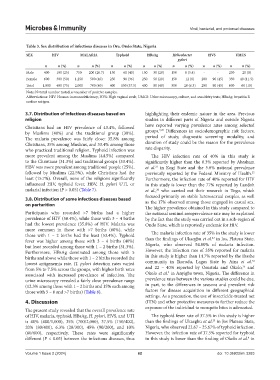
            Table 3. Sex distribution of infectious diseases in Ore, Ondo State, Nigeria
            SEX        HIV         MALARIA        Typhoid       HBsAg     Helicobacter    HVS        UMCS
                                                                             pylori
                    n     n (%)   n     n (%)   n     n (%)   n    n (%)  n     n (%)  n    n (%)  n    n (%)
            Male    400  100 (25)  750  200 (26.7)  150  60 (40)  150  30 (20)  150  8 (5.4)  -  -  250  20 (8)
            Female  600  300 (50)  1,250  500 (40)  250  90 (36)  250  50 (20)  150  12 (8)  200  90 (45)  350  40 (11.5)
            Total  1,000  400 (75)  2,000  700 (40)  400  150 (37.5)  400  80 (40)  300  20 (6.3)  200  90 (45)  600  60 (10)
            Note: N=total number tested; n=number of positive samples.
            Abbreviations: HIV: Human immunodeficiency; HVS: High vaginal swab; UMCS: Urine microscopy, culture, and sensitivity tests; HBsAg: hepatitis B
            surface antigen.

            3.7. Distribution of infectious diseases based on   highlighting their endemic nature in the area. Previous
            religion                                           studies in different parts of Nigeria and outside Nigeria
            Christians had an HIV prevalence of 43.4%, followed   have reported  varying prevalence rates among  selected
                                                                     9,20
            by Muslims (40%) and the traditional group (30%).   groups.  Differences in sociodemographic  risk factors,
            The malaria prevalence was fairly close: 35.8% among   period of  study, diagnostic  screening  modality, and
            Christians, 35% among Muslims, and 33.4% among those   duration of study could be the reason for the prevalence
            who practiced traditional religion. Typhoid infection was   rate disparity.
            more prevalent among the Muslims (44.5%) compared    The HIV infection rate of 40% in this study is
            to the Christians (31.3%) and traditional groups (33.4%).   significantly higher than the 0.3% reported by Abraham
            HBV was more prevalent among traditional people (25%),   et al.  in Kogi State and the 5.0% national prevalence
                                                                   21
            followed by Muslims (22.5%), while Christians had the   previously reported by the Federal Ministry of Health.
                                                                                                            22
            least (15.7%). Overall, none of the religions significantly   Furthermore, the infection rate of 40% reported for HIV
            influenced HIV, typhoid fever, HBV,  H. pylori UTI, or   in this study is lower than the 77% reported by Landoh
            malarial infection (P > 0.05) (Table 7).           et al.,  who carried out their research in Togo, which
                                                                    20
                                                               focused primarily on stable heterosexual couples, as well
            3.8. Distribution of some infectious diseases based
            on parturition                                     as the 17% observed among those engaged in casual sex.
                                                               The higher prevalence obtained in this study compared to
            Participants  who  recorded  >7  births  had  a  higher   the national sentinel seroprevalence rate may be explained
            prevalence of HIV (58.4%), while those with 3 – 4 births   by the fact that the study was carried out in a sub-region of
            had the lowest prevalence (35.8%) of HIV. Malaria was   Ondo State, which is reportedly endemic for HIV.
            more common in those with >7 births (60%), while
            those with 1 – 2 births had the least (53.4%). Typhoid   The malaria infection rate of 35% in the study is lower
                                                                                           23
            fever was higher among those with 3 – 4 births (40%)   than the findings of Ukaegbu et al.  in Jos, Plateau State,
            but least recorded among those with 1 – 2 births (31.3%).   Nigeria, who observed 54.00% of malaria infection.
            Furthermore, HBsAg dominated among those with 5    However, the infection rate of 35% reported for malaria
            births and above while those with 1 – 2 births recorded the   in this study is higher than 14.7% reported by the Ibashe
                                                                                                            24
            lowest antigenemia rate.  H. pylori detection rates varied   community in Ikorodu, Lagos State by Aina  et al.
                                                                                                        25
            from 5% to 7.5% across the groups, with higher birth rates   and 22 – 40% reported by Omatola and Okolo,  and
                                                                        4
            associated with increased prevalence of infection. The   Okolo et al.  in Anyigba town, Nigeria. The difference in
            urine microscopy revealed a fairly close prevalence range   prevalence rates between the various studies could be due,
            (12.3% among those with 1 – 2 births and 15% each among   in part, to the differences in seasons and prevalent risk
            those with 5 – 6 and >7 births) (Table 8).         factors for disease acquisition in different geographical
                                                               settings. As a precaution, the use of insecticide-treated net
            4. Discussion                                      (ITN) and other protective measures to further reduce the
                                                               exposure of the individual to mosquito bites is advocated.
            The present study revealed that the overall prevalence rate
            of HIV, malaria, typhoid, HBsAg, H. pylori, HVS, and UTI   The typhoid fever rate of 37.5% in this study is higher
                                                                                           23
            is 40% (400/1,000), 35% (700/2,000), 37.5% (150/400),   than the findings of Ukaegbu et al.  in Jos Plateau State,
            20% (80/400), 6.3% (20/300), 45% (90/200), and 10%   Nigeria, who observed 22.67 – 25.67% of typhoid infection.
            (60/600),  respectively.  These  rates  were  significantly   However, the infection rate of 37.5% reported for typhoid
            different (P < 0.05) between the infectious diseases, thus   in this study is lower than the finding of Okolo et al.  in
                                                                                                          4

            Volume 1 Issue 2 (2024)                         62                               doi: 10.36922/mi.3283

