


Page 113 - MI-2-1
P. 113
Microbes & Immunity                                                 Anti-mouse CXCR5 monoclonal antibody


                         A


                         B


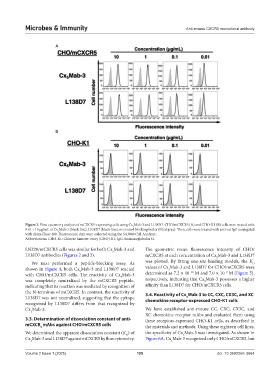
            Figure 2. Flow cytometry analysis of mCXCR5-expressing cells using Cx Mab-3 and L138D7. CHO/mCXCR5 (A) and CHO-K1 (B) cells were treated with
                                                          5
            0.01 – 10 µg/mL of Cx Mab-3 (black line), L138D7 (black line), or control blocking buffer (filled gray). Then, cells were treated with anti-rat IgG conjugated
                          5
            with Alexa Fluor 488. Fluorescence data were collected using the SA3800 Cell Analyzer.
            Abbreviations: CHO-K1: Chinese hamster ovary (CHO)-K1; IgG: Immunoglobulin G.
            LN229/mCXCR5 cells was similar for both Cx Mab-3 and   The geometric mean fluorescence intensity of CHO/
                                                 5
            L138D7 antibodies (Figures 2 and 3).               mCXCR5 at each concentration of Cx Mab-3 and L138D7
                                                                                             5
              We next performed a peptide-blocking assay. As   was plotted. By fitting one-site binding models, the  K
                                                                                                            D
            shown in Figure 4, both Cx Mab-3 and L138D7 reacted   values of Cx Mab-3 and L138D7 for CHO/mCXCR5 were
                                                                         5
                                   5
                                                                                  −10
                                                                                                 −9
            with CHO/mCXCR5  cells. The reactivity of Cx Mab-3   determined as 7.2 × 10  M and 7.0 × 10  M (Figure 5),
                                                    5
            was completely neutralized by the mCXCR5 peptide,   respectively, indicating that Cx Mab-3 possesses a higher
                                                                                        5
            indicating that its reaction was mediated by recognition of   affinity than L138D7 for CHO/mCXCR5 cells.
            the N-terminus of mCXCR5. In contrast, the reactivity of   3.4. Reactivity of Cx Mab-3 to CC, CXC, CX3C, and XC
            L138D7 was not neutralized, suggesting that the epitope   chemokine receptor-expressed CHO-K1 cells
                                                                                5
            recognized  by  L138D7  differs  from  that  recognized  by
            Cx Mab-3.                                          We have established anti-mouse CC, CXC, CX3C, and
              5
                                                               XC chemokine receptor mAbs and evaluated them using
            3.3. Determination of dissociation constant of anti-  these receptors-expressed CHO-K1 cells, as described in
            mCXCR  mAbs against CHO/mCXCR5 cells
                  5                                            the materials and methods. Using these eighteen cell lines,
            We determined the apparent dissociation constant (K ) of   the specificity of Cx Mab-3 was investigated. As shown in
                                                       D
                                                                               5
            Cx Mab-3 and L138D7 against mCXCR5 by flow cytometry.   Figure 6A, Cx Mab-3 recognized only CHO/mCXCR5, but
              5
                                                                          5
            Volume 2 Issue 1 (2025)                        105                               doi: 10.36922/mi.5664

