


Page 112 - MI-2-1
P. 112
Microbes & Immunity                                                 Anti-mouse CXCR5 monoclonal antibody


                          A


                          B


                          C


                          D


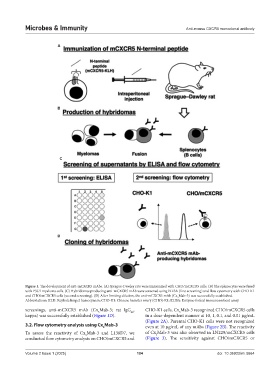
            Figure 1. The development of anti-mCXCR5 mAbs. (A) Sprague-Dawley rats were immunized with CHO/mCXCR5 cells. (B) The splenocytes were fused
            with P3U1 myeloma cells. (C) Hybridomas producing anti-mCXCR5 mAb were screened using ELISA (first screening) and flow cytometry with CHO-K1
            and CHO/mCXCR5 cells (second screening). (D) After limiting dilution, the anti-mCXCR5 mAb (Cx Mab-3) was successfully established.
                                                                             5
            Abbreviations: KLH: Keyhole limpet hemocyanin; CHO-K1: Chinese hamster ovary (CHO)-K1; ELISA: Enzyme-linked immunosorbent assay.
            screenings, anti-mCXCR5 mAb (Cx Mab-3; rat IgG ,   CHO-K1 cells. Cx Mab-3 recognized CHO/mCXCR5 cells
                                           5
                                                         2b
                                                                             5
            kappa) was successfully established (Figure 1D).   in a dose-dependent manner at 10, 1, 0.1, and 0.01 μg/mL
                                                               (Figure 2A). Parental CHO-K1 cells were not recognized
            3.2. Flow cytometry analysis using Cx Mab-3        even at 10 μg/mL of any mAbs (Figure 2B). The reactivity
                                             5
            To  assess the  reactivity of  Cx Mab-3  and L138D7,  we   of Cx Mab-3 was also observed in LN229/mCXCR5 cells
                                                                   5
                                     5
            conducted flow cytometry analysis on CHO/mCXCR5 and   (Figure  3). The sensitivity against CHO/mCXCR5 or
            Volume 2 Issue 1 (2025)                        104                               doi: 10.36922/mi.5664

