


Page 119 - MI-2-2
P. 119
Microbes & Immunity                                               Physiological and cognitive effects of PASC


              Gender differences were more pronounced in cognitive   Figures S12-S29. The analyses also examined the correlation
            symptoms. Females reported a higher median score of   between COVID-19 booster shot status (no booster, one,
            0.267 for mental severity compared to 0.033 in males   two, and three boosters) and symptom severity, specifically
            (Figure S4). The standard deviation for females was also   depression, behavior, stress, and chronic pain. In
            greater (0.41 versus 0.28 for males). These disparities were   depression severity, those in the no-booster group showed
            even more pronounced in the mental duration, where   a mean score of 0.357, while those with three boosters
            females showed a median score of 0.4 compared to 0.1 in   scored 0 for both depression severity and duration. In
            males (Figure S3), with standard deviations of 0.91 and   behavior symptoms, the no-booster group showed a mean
            0.47, respectively.  Additional gender-based comparisons   severity  score  of  0.571,  while  the  three-booster  group
            are presented in Figures S6-S11.                   scored 0.111. The stress duration averaged 1.143 for the
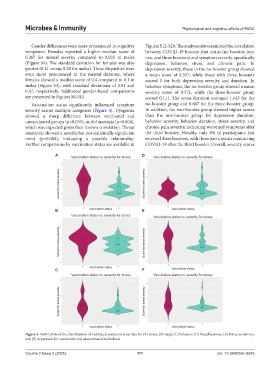
              Vaccination status significantly influenced symptom   no-booster group and 0.667 for the three-booster group.
            severity across multiple categories (Figure  4). Dysgeusia   In addition, the two-booster group showed higher scores
            showed a sharp difference between vaccinated and   than the one-booster group for depression duration,
            unvaccinated groups (p=0.033), as did anosmia (p=0.004),   behavior severity, behavior duration, stress severity, and
            which was expected given their known correlation. Throat   chronic pain severity, indicating worsened symptoms after
            sensitivity showed a notable but not statistically significant   the  third  booster.  Notably,  only 8%  of  participants  had
            trend (p=0.080), indicating a possible relationship.   received three boosters, with three participants contracting
            Further comparisons by vaccination status are available in   COVID-19 after the third booster. Overall, severity scores
                         A                                   D


                         B                                   E


                         C                                    F


            Figure 4. Violin plots of the distributions of individual symptom severities for (A) stress, (B) sleep, (C) behavior, (D) breathlessness, (E) throat sensitivity,
            and (F) depression for vaccinated and unvaccinated individuals


            Volume 2 Issue 2 (2025)                        111                               doi: 10.36922/mi.8545

