


Page 62 - MI-2-2
P. 62
Microbes & Immunity                                                Phylogenetic analysis of HPV16 L1 in Asia


            accounting for nearly seven out of ten cervical cancers
            reported globally.  Further analysis reveals that this ratio
                          5
            remains consistently similar regionally. HPV infection
            remains  a significant public  health  concern, particularly
            in Asia, where cervical cancer accounts for a substantial
            proportion of female cancer-related mortality. According to
            the WHO reports, over 60% of cervical cancer cases in Asia
            are linked to HPV-16 and 18, with variations in prevalence
            across different countries. In Southern and Western Asia,
            HPV-16 and 18 infections contribute to more than 80% of
            cervical cancer cases.  In addition, HPV-related anogenital
                             5
            and oropharyngeal cancers are increasingly reported
            among men, with incidence rates varying from 17 to
            43 cases per million depending on geographical location.
                                                          5
            In the Asian region, the rate of cervical cancer due to HPV-
            16 and 18 infections is 68% among infected women, and
            in Southern and Western Asia, this rate exceeds 80%.  In
                                                       5
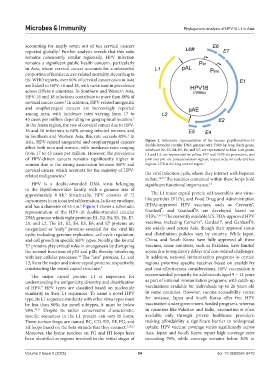
            Asia, HPV-related anogenital and oropharyngeal cancers   Figure  1. Schematic representation of the human papillomavirus-16
            affect both men and women, with incidence rates ranging   double-stranded circular DNA genome with 7,908 bp long. Early genes,
                                                               which are E1, E2, E4, E5, E6, and E7, are represented in blue. Late genes,
            from 17 to 43 cases per million. However, the prevalence   L1 and L2, are represented in yellow. P97 and P670 are promoters, and
            of HPV-driven cancers remains significantly higher in   pAE and pAL are polyadenylation signals, respectively, for early and late
            women due to the strong association between HPV and   regions. LCR is the long control region. 7
            cervical cancer, which accounts for the majority of HPV-  the viral infection cycle, where they interact with heparan
            related malignancies. 5
                                                               sulfate. 14,15  The residues contained within these loops hold
              HPV is a double-stranded DNA virus belonging     significant functional importance. 14
            to the  Papillomaviridae family, with a genome size of
            approximately 8  kb.  Structurally, HPV consists of 72   The L1 major capsid protein self-assembles into virus-
                             6
            capsomeres in an icosahedral formation, lacks an envelope,   like particles (VLPs), and Food Drug and Administration
            and has a diameter of 55 nm.  Figure 1 shows a schematic   (FDA)-approved HPV vaccines, such as Cervarix®,
                                   6
                                                                                    ®
                                                                      ®
            representation  of  the  HPV-16  double-stranded  circular   Gardasil , and Gardasil 9, are developed based on
            DNA genome which eight proteins: E1, E2, E4, E5, E6, E7,   VLPs. 3,16-19  The currently available U.S. FDA-approved HPV
                                                                                                           ®
            L1, and L2. The E1, E2, E4, E5, E6, and E7 proteins are   vaccines, including Cervarix®, Gardasil®, and Gardasil 9,
            categorized  as  “early”  proteins  essential  for the viral life   are widely used across Asia, though their approval status
            cycle, including genome replication, cell cycle regulation,   and  distribution  policies  vary  by  country.  While  Japan,
            and cell growth in specific HPV types. Notably, the E6 and   China, and South  Korea have fully approved all three
            E7 proteins play critical roles in oncogenesis by disrupting   vaccines, some countries, such as Pakistan, have limited
            the normal functions of p53 and pRb, thereby interfering   access due to regulatory delays and cost-related challenges.
            with key cellular processes.  The “late” proteins, L1 and   In addition, national immunization  programs  in certain
                                  7,8
            L2, form the major and minor capsid proteins, respectively,   regions prioritize specific vaccines based on availability
            constructing the virus’s capsid structure. 9       and cost-effectiveness considerations. HPV vaccination is
              The major capsid protein L1 is important for     recommended primarily for adolescents aged 9 – 14 years
            understanding the antigenicity, diversity, and classification   as part of national immunization programs, with catch-up
            of HPV.  HPV types are classified based on nucleotide   vaccinations available for individuals up to 26  years old
                   9
            similarity  in  their  L1  sequences.  To  name  a  novel  HPV   in some countries. However, vaccine accessibility varies;
            type, its L1 sequence similarity with other virus types must   for instance, Japan and South  Korea offer free HPV
            be less than 90%; for novel subtypes, it must be below   vaccination under government-funded programs, whereas
            98%. 10,11  Despite its rather conservative characteristic,   in countries like Pakistan and India, vaccination is often
            specific sequences in the L1 protein can vary in loops.   available only through private healthcare providers,
            These surface loops are named BC, CD, DE, EF, FG, and   making affordability a significant barrier to widespread
            HI loops based on the beta strands that they connect. 3,12,13    uptake. HPV vaccine coverage varies significantly across
            Moreover, the lysine residues on FG and HI loops have   Asia. Japan and South  Korea report high coverage rates
            been identified as regions involved in the initial stages of   exceeding 70%, while coverage remains below 30% in


            Volume 2 Issue 2 (2025)                         54                               doi: 10.36922/mi.8410

