


Page 64 - MI-2-2
P. 64
Microbes & Immunity                                                Phylogenetic analysis of HPV16 L1 in Asia


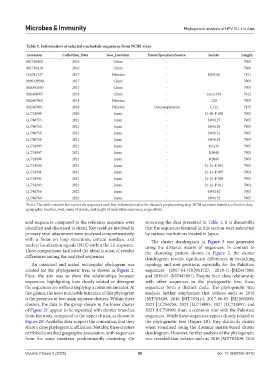
            Table 1. Information of selected nucleotide sequences from NCBI virus
            Accession       Collection_Date   Geo_Location      Tissue/Specimen/Source    Isolate       Length
            MT783409            2016             China                  -                                7908
            MT783410            2016             China                  -                                7906
            OQ911727            2017             Pakistan               -                 HNC49          7171
            MW320358            2017             China                  -                                7909
            MH892050            2017             China                  -                                7905
            MK484705            2018             China                  -                xuca1916        7912
            MZ447800            2018             Pakistan               -                  C50           7909
            MZ447801            2019             Pakistan          Oronasopharynx         C122           7155
            LC718899            2020              Japan                 -               21-20-P-002      7905
            LC786753            2021              Japan                 -                SW0127          7905
            LC786755            2021              Japan                 -                SW0129          7905
            LC786756            2021              Japan                 -                SW0131          7905
            LC786758            2021              Japan                 -                SW0138          7909
            LC718895            2021              Japan                 -                 K3131          7905
            LC718897            2021              Japan                 -                 K5048          7905
            LC718898            2021              Japan                 -                 K5060          7909
            LC718900            2021              Japan                 -               21-21-P-001      7905
            LC718901            2021              Japan                 -               21-21-P-007      7904
            LC718902            2021              Japan                 -               21-21-P-008      7905
            LC718903            2021              Japan                 -               21-21-P-011      7904
            LC786759            2022              Japan                 -                SW0142          7905
            LC786760            2022              Japan                 -                SW0152          7905
            Notes: The table contains the nucleotide sequences and their information after the dataset’s preprocessing step: NCBI accession number, collection date,
            geographic location, host, name of isolate, and length of nucleotide sequences, respectively.

            acid sequences compared to the reference sequence were   reviewing the data presented in Table 1, it is discernible
            identified and discussed in detail. Key residues involved in   that the sequences featured in this section were submitted
            primary viral attachment were analyzed comprehensively,   by various institutions located in Japan.
            with  a  focus  on loop  structures,  critical residues,  and   The cluster dendrogram in  Figure 3 was generated
            nuclear localization signals (NLS) within the L1 sequence.   using the distance matrix of sequences. In contrast to
            These comparisons facilitated the identification of residue   the clustering pattern shown in  Figure 2, the cluster
            differences among the analyzed sequences.          dendrogram reveals significant differences in branching
              An unrooted and scaled rectangular phylogram was   topology and root positions, especially for the Pakistani
            created for the phylogenetic tree, as shown in  Figure  2.   sequences (2017-01-|OQ911727, 2018-11-|MZ447800,
            Here,  the  aim was  to  show the relationships  between   and 2019-01-|MZ447801). Despite their close relationship
            sequences, highlighting how closely related or divergent   with other sequences in the phylogenetic tree, these
            the sequences are without implying a common ancestor. At   sequences  form  a  distinct  clade.  The  phylogenetic  tree
            first glance, the most noticeable inference of this phylogram   analysis further emphasizes that isolates such as 2016
            is the presence of two main separate clusters. Within these   |MT783409,  2016  |MT783410,  2017-06-05  |MH892050,
            clusters, the data in the group shown in the lower cluster   2021 |LC786758, 2021 |LC718895, 2021 |LC718897, and
            of Figure 2C appear to be separated with shorter branches   2021 |LC718901 share a common root with the Pakistani
            from the roots, compared to the upper cluster, as shown in   sequences. While these sequences appear closely related in
            Figure 2B. Available data support the contention that they   the phylogenetic tree (Figure 2B), they distinctly cluster
            share a close phylogenetic affiliation. Notably, these clusters   when visualized using the distance matrix-based cluster
            exhibited a marked geographic association, with sequences   dendrogram. However, further analysis of the phylogenetic
            from the same countries predominantly clustering. On   tree revealed that isolates such as 2016 |MT783409, 2016


            Volume 2 Issue 2 (2025)                         56                               doi: 10.36922/mi.8410

