


Page 66 - MI-2-2
P. 66
Microbes & Immunity                                                Phylogenetic analysis of HPV16 L1 in Asia


                         A                                     B


                                                               C


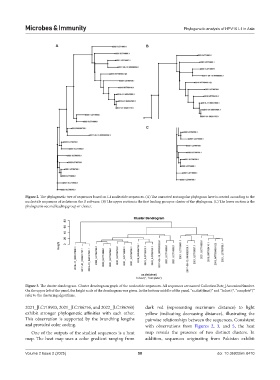
            Figure 2. The phylogenetic tree of sequences based on L1 nucleotide sequences. (A) The unrooted rectangular phylogram here is created according to the
            nucleotide sequences of isolates on the R software. (B) The upper section is the first leading group or cluster of the phylogram. (C) The lower section is the
            phylogram’s second leading group or cluster.


            Figure 3. The cluster dendrogram. Cluster dendrogram graph of the nucleotide sequences. All sequences are named CollectionDate_|AccessionNumber.
            On the upper left of the panel, the height scale of the dendrogram was given. In the bottom-middle of the panel, “as.dist(dmat)” and “hclust (*, “complete”)”
            refer to the clustering algorithms.

            2021_|LC718903, 2021_|LC786756, and 2022_|LC786760)   dark red (representing maximum distance) to light
            exhibit stronger phylogenetic affinities with each other.   yellow (indicating decreasing distance), illustrating the
            This observation is supported by the branching lengths   pairwise relationships between the sequences. Consistent
            and provided color coding.                         with  observations  from  Figures  2,  3,  and  5,  the  heat

              One of the outputs of the studied sequences is a heat   map reveals the presence of two distinct clusters. In
            map. The heat map uses a color gradient ranging from   addition,  sequences  originating  from  Pakistan  exhibit


            Volume 2 Issue 2 (2025)                         58                               doi: 10.36922/mi.8410

