


Page 68 - MI-2-2
P. 68
Microbes & Immunity                                                Phylogenetic analysis of HPV16 L1 in Asia


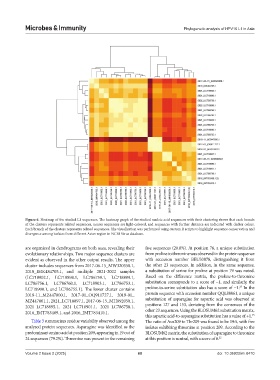
            Figure 6. Heatmap of the studied L1 sequences. The heatmap graph of the studied nucleic acid sequences with their clustering shows that each branch
            of the clusters represents related sequences, nearer sequences are light-colored, and sequences with further distance are indicated with darker colors.
            Each branch of the clusters represents related sequences. The visualization was performed using custom R scripts to highlight sequence conservation and
            divergence among isolates from different Asian region in NCBI Virus database.


            are organized in dendrograms on both axes, revealing their   five sequences (20.8%). At position 76, a unique substitution
            evolutionary relationships. Two major sequence clusters are   from proline to threonine was observed in the protein sequence
            evident as observed in the other output results. The upper   with accession number BEU33878, distinguishing it from
            cluster includes sequences from 2017-06-15_MW320358.1,   the  other  23  sequences.  In  addition,  in  the  same  sequence,
            2018_IMK484705.1, and multiple 2021-2022  samples   a substitution of serine for proline at position 79 was noted.
            (LC718902.1, LC718898.1, LC786759.1, LC718899.1,   Based on the difference matrix, the proline-to-threonine
            LC786756.1, LC786760.1, LC718903.1, LC786753.1,    substitution corresponds to a score of −1, and similarly, the
                                                                                                       25
            LC718900.1, and LC786755.1). The lower cluster contains   proline-to-serine substitution also has a score of −1.  In the
            2018-11_MZ447800.1, 2017-01_OQ911727.1, 2019-01_   protein sequence with accession number QQL88061, a unique
            MZ447801.1, 2021_LC718897.1, 2017-06-15_MH892050.1,   substitution of asparagine for aspartic acid was observed at
            2021_LC718895.1,  2021_LC718901.1, 2021_LC786758.1,   positions 127 and 153, deviating from the consensus of the
            2016_IMT783409.1, and 2016_IMT783410.1.            other 23 sequences. Using the BLOSUM62 substitution matrix,
                                                               this aspartic acid-to-asparagine substitution has a value of +1.
                                                                                                            25
              Table 3 summarizes residue variability observed among the   The ratio of Asn209 to Thr209 was found to be 19:5, with five
            analyzed protein sequences. Asparagine was identified as the   isolates exhibiting threonine at position 209. According to the
            predominant amino acid at position 209, appearing in 19 out of   BLOSUM62 matrix, the substitution of asparagine to threonine
            24 sequences (79.2%). Threonine was present in the remaining   at this position is neutral, with a score of 0. 25


            Volume 2 Issue 2 (2025)                         60                               doi: 10.36922/mi.8410

