


Page 65 - MI-2-2
P. 65
Microbes & Immunity                                                Phylogenetic analysis of HPV16 L1 in Asia


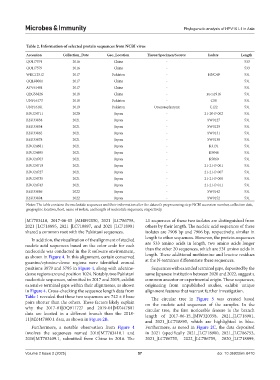
            Table 2. Information of selected protein sequences from NCBI virus
            Accession       Collection_Date    Geo_Location     Tissue/Specimen/Source    Isolate       Length
            QOI17574            2016              China                 -                                533
            QOI17579            2016              China                 -                                533
            WKC12512            2017             Pakistan               -                HNC49           531
            QQL88061            2017              China                 -                                531
            AYV61481            2017              China                 -                                531
            QEG53826            2018              China                 -                xuca1916        531
            UNF16173            2018             Pakistan               -                  C50           531
            UNF16181            2019             Pakistan          Oronasopharynx         C122           531
            BDO24711            2020              Japan                 -               21-20-P-002      531
            BEU33838            2021              Japan                 -                SW0127          531
            BEU33854            2021              Japan                 -                SW0129          531
            BEU33862            2021              Japan                 -                SW0131          531
            BEU33878            2021              Japan                 -                SW0138          531
            BDO24681            2021              Japan                 -                 K3131          531
            BDO24695            2021              Japan                 -                 K5048          531
            BDO24703            2021              Japan                 -                 K5060          531
            BDO24719            2021              Japan                 -               21-21-P-001      531
            BDO24727            2021              Japan                 -               21-21-P-007      531
            BDO24735            2021              Japan                 -               21-21-P-008      531
            BDO24743            2021              Japan                 -               21-21-P-011      531
            BEU33886            2022              Japan                 -                SW0142          531
            BEU33894            2022              Japan                 -                SW0152          531
            Notes: The table contains the nucleotide sequences and their information after the dataset’s preprocessing step: NCBI accession number, collection date,
            geographic location, host, name of isolate, and length of nucleotide sequences, respectively.

            |MT783410, 2017-06-05 |MH892050, 2021 |LC786758,   L1 sequences of these two isolates are distinguished from
            2021 |LC718895, 2021 |LC718897, and 2021 |LC718901   others by their length. The nucleic acid sequences of these
            shared a common root with the Pakistani sequences.  isolates are 7908 bp and 7906 bp, respectively, similar in
              In addition, the visualization of the alignment of studied   length to other sequences. However, the protein sequences
            nucleic acid sequences based on the color code for each   are 533 amino acids in length, two amino acids longer
            nucleotide was conducted in the R software environment,   than the other 20 sequences, which are 531 amino acids in
            as shown in Figure 4. In this alignment, certain conserved   length. These additional methionine and leucine residues
            guanine/cytosine-dense regions  were identified around   at the N-terminus differentiate these sequences.
            positions 3979 and 5795 in Figure 4, along with adenine-  Sequences with extended terminal gaps, deposited by the
            dense regions around position 1024. Notably, two Pakistani   same Japanese institution between 2020 and 2022, suggest a
            nucleotide sequences, submitted in 2017 and 2019, exhibit   common ancestor or experimental origin. These sequences,
            extensive terminal gaps within their alignments, as shown   originating from unpublished studies, exhibit unique
            in Figure 4. Cross-checking the sequence length data from   alignment features that warrant further investigation.
            Table 1 revealed that these two sequences are 742 ± 8 base   The  circular  tree in  Figure  5  was created based
            pairs shorter than the others. These factors likely explain   on the nucleic acid sequences of the samples. In the
            why the 2017-01|OQ911727 and 2019-01|MZ447801      circular tree, the first noticeable feature is the branch
            data are located in a different branch than the 2018-  length of 2017-06-15_|MW320358, 2021_|LC718901,
            11|MZ447800.1 data, as shown in Figure 2B.         and 2021_|LC718895, which are highlighted in blue.
              Furthermore, a notable observation from  Figure  4   Furthermore, as noted in  Figure  2C, the data deposited
            involves the sequences named 2016|MT783410.1 and   in 2021 (specifically 2021_|LC718900, 2021_|LC786753,
            2016|MT783409.1, submitted from China in 2016. The   2021_|LC786755,  2022_|LC786759, 2020_|LC718899,


            Volume 2 Issue 2 (2025)                         57                               doi: 10.36922/mi.8410

